
Overlanding and Backroad Adventures: When to Choose the Rugged Trail Climber RT
A practical guide for Canadian truck and SUV drivers deciding whether the Summit Trail Climber RT is the right tire for overlanding, gravel roads, remote campsites, muddy trails, and everyday driving.
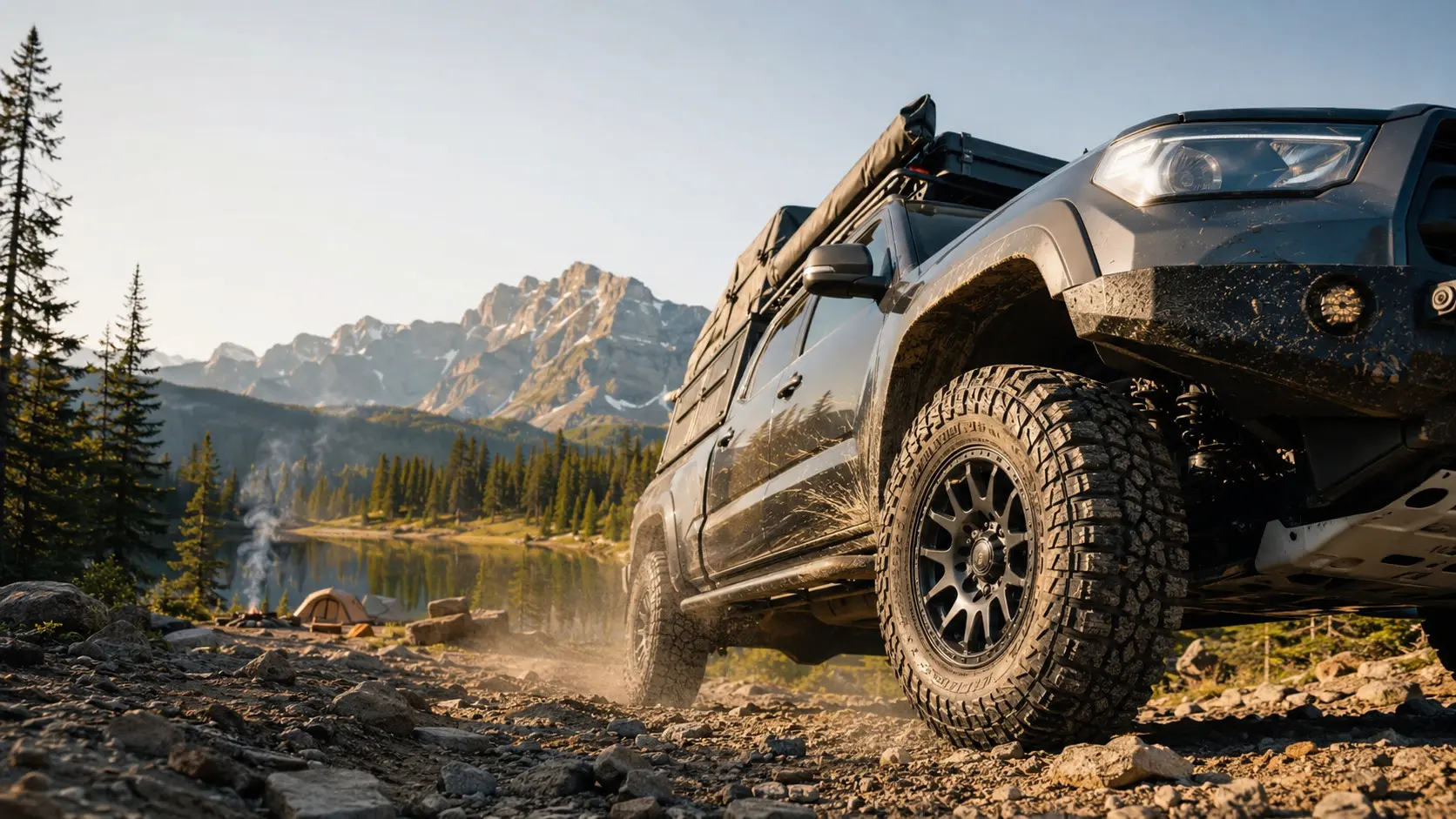
Overlanding and Backroad Adventures: When to Choose the Summit Trail Climber RT
The best overlanding tire is not necessarily the most aggressive tire available. It is the tire that matches how far you travel on pavement, the terrain you expect beyond the highway, the weight of your equipment, and the conditions you may encounter on the way home.
The Summit Trail Climber RT is a rugged-terrain tire designed for light trucks and SUVs that divide their time between paved roads and more demanding surfaces. Its deep stepped tread lugs, scalloped shoulders, aggressive sidewall biters, on-road/off-road compound, and Three-Peak Mountain Snowflake marking position it between a conventional all-terrain tire and a dedicated mud-terrain tire. :contentReference[oaicite:0]{index=0}
That combination can make sense for Canadian drivers travelling on forestry roads, cottage access routes, gravel concessions, muddy trail systems, rocky approaches, and snow-covered backroads. However, it is not automatically the right choice for every pickup, SUV, season, or driving routine.
What Is the Summit Trail Climber RT?
The Summit Trail Climber RT is a rugged-terrain tire for drivers who need more off-road capability than a typical all-terrain tire without moving completely to a mud-terrain design.
Rugged-terrain, sometimes shortened to R/T, is a category commonly positioned between all-terrain and mud-terrain tires. Compared with a moderate all-terrain tread, an R/T tire normally uses larger tread blocks, more open voids, stronger-looking shoulders, and additional sidewall features. Compared with a mud-terrain tire, it generally attempts to preserve better stability, comfort, and everyday usability on pavement.
The Trail Climber RT follows that approach. Summit describes it as suitable for conditions ranging from rugged trails to urban streets. Its current size catalogue includes standard-load or extra-load fitments as well as LT sizes with 10-ply-rated and 12-ply-rated constructions. Tread depth varies by size, with many passenger or XL fitments listed at 16/32 inch and numerous LT fitments listed at 18/32 inch. :contentReference[oaicite:1]{index=1}
| Trail Climber RT feature | Why it matters on backroads | What the driver should consider |
|---|---|---|
| Deep stepped tread lugs | Creates multiple biting edges for loose gravel, dirt, mud, and uneven surfaces | A more open tread can produce more road noise than a highway-focused tire |
| Scalloped shoulders | Helps the outer tread engage when travelling through ruts or softer terrain | Shoulder traction does not eliminate the risk of becoming stuck |
| Aggressive sidewall biters | Can provide additional engagement when the tire is working against loose trail edges | Sidewall features do not make a tire immune to punctures or impact damage |
| On-road/off-road rubber compound | Supports mixed use rather than limiting the tire to recreational trails | Wear still depends on inflation, alignment, rotation, load, and driving style |
| 3PMSF marking | Indicates that the tire meets a defined performance requirement for traction on medium-packed snow | The symbol is not a complete measure of ice braking or all winter performance |
| Passenger, XL, and LT fitments | Provides options for different SUVs, pickups, payloads, and wheel sizes | The exact size, load index, speed rating, and construction must match the vehicle |
When Should You Choose the Trail Climber RT?
Choose the Trail Climber RT when your driving regularly includes rough, loose, or unpredictable surfaces, but you still need to cover meaningful distances on paved roads.
You Regularly Drive Forestry Roads and Gravel Routes
Gravel roads can change quickly. A maintained access road may be firm and smooth in the morning but develop loose corners, washboard sections, exposed rocks, potholes, and standing water after traffic or heavy rain.
The Trail Climber RT’s stepped lugs and open shoulder design are better aligned with these changing surfaces than a highway-terrain tire with closely spaced tread blocks. The benefit is most relevant when gravel and dirt are part of your normal driving rather than a once-a-year detour.
Potential use cases include:
- Forestry and resource roads in British Columbia or Alberta
- Crown land and camping access routes in Ontario
- Cottage roads in Ontario, Quebec, and Atlantic Canada
- Prairie grid roads that become soft after rainfall
- Hunting, fishing, paddling, and trailhead access
- Remote job sites reached by gravel or unmaintained roads
Expert tip: Aggressive tread can improve available traction, but speed remains one of the most important variables on gravel. Slow down before loose corners, washboard surfaces, blind crests, and areas where sharp stones have collected.
Your Overlanding Routes Include Mud, Ruts, and Soft Trail Sections
A mild all-terrain tire may be sufficient for dry gravel, but deeper voids and more assertive shoulders become more valuable when a trail includes mud, ruts, wet grass, or soft forest soil.
The Trail Climber RT is a sensible candidate when these conditions occur frequently enough to justify a more aggressive tread, but not frequently enough to accept all the compromises of a mud-terrain tire. Its tread design should generally clear loose material more effectively than a tightly packed highway tread, although actual mud performance will depend on mud depth, soil type, vehicle weight, wheel speed, and four-wheel-drive capability.
It is important to recognize the limit. A rugged-terrain tire does not transform a stock crossover or pickup into a recovery vehicle. Deep mud can overwhelm any tread, particularly when the vehicle has limited ground clearance or is carrying substantial weight.
You Want More Trail Capability Without Committing to a Mud-Terrain Tire
Many overlanding vehicles spend most of their kilometres travelling to and from the trail. A weekend route may include 400 kilometres of highway followed by only 40 kilometres of dirt.
For that type of mixed use, a mud-terrain tire can be more aggressive than necessary. Its larger voids and heavier construction may bring additional noise, rolling resistance, steering changes, and wear considerations. A rugged-terrain tire provides a middle option for drivers who have outgrown a mild all-terrain pattern but do not spend most of their time in deep mud or technical rock terrain.
Your Vehicle Carries Camping or Work Equipment
Overlanding equipment adds weight quickly. Roof tents, drawer systems, recovery boards, water, fuel, tools, coolers, auxiliary batteries, and passengers all contribute to the vehicle’s operating load.
The Trail Climber RT range includes multiple LT fitments with higher load indices and 10-ply-rated or 12-ply-rated constructions. Those options may be appropriate for certain pickups and heavily equipped SUVs, but a higher ply rating should not be selected solely because it sounds stronger. Heavier-duty construction can affect ride comfort, steering feel, unsprung weight, and the inflation pressure needed to support the actual load. :contentReference[oaicite:2]{index=2}
Always verify:
- The original equipment tire size or an approved alternative size
- Minimum load index required by the vehicle manufacturer
- Required speed rating
- Wheel width and diameter compatibility
- Clearance at full steering lock and suspension compression
- Gross vehicle weight rating and axle weight ratings
- Whether suspension or gearing changes are required for an oversized tire
You Travel During the Canadian Shoulder Seasons
The Trail Climber RT carries the Three-Peak Mountain Snowflake, or 3PMSF, symbol. This indicates that the tire meets a prescribed traction threshold on medium-packed snow. Transport Canada advises drivers to look for the mountain-and-snowflake symbol when selecting tires for severe snow conditions.
This can be useful for fall and spring adventures when gravel roads may be covered by early snow, slush, or rapidly changing mountain weather. It may also help the tire meet posted winter-tire requirements on some routes, depending on the province, vehicle, tread depth, and applicable regulation.
When Is the Trail Climber RT Probably Not the Best Choice?
Look at another tire category when quiet highway travel, maximum winter specialization, or extreme off-road performance matters more than mixed-surface versatility.
Your Driving Is Almost Entirely Urban or Highway Based
A highway-terrain or less aggressive all-terrain tire will often be the better fit when nearly every kilometre is driven on pavement. Closely spaced tread patterns are generally selected to support quieter operation, predictable highway behaviour, lower rolling resistance, and even wear.
The Trail Climber RT may still be road-capable, but buying it primarily for its appearance can mean accepting trade-offs without receiving much practical benefit from its off-road features.
You Need a Dedicated Tire for Deep Mud or Technical Rock Crawling
Drivers who routinely enter deep mud, severe ruts, or highly technical rock trails may prefer a dedicated mud-terrain tire with larger voids and a more specialized carcass and sidewall design.
The Trail Climber RT is better understood as a mixed-use tire than as a competition or extreme-crawling tire. Recovery equipment, route planning, ground clearance, suspension travel, and driver skill remain essential regardless of tread choice.
You Frequently Drive on Ice or in Severe Winter Conditions
Canadian overlanders who regularly drive on ice, hard-packed snow, or consistently cold roads should compare the Trail Climber RT with a dedicated winter tire. Transport Canada recommends winter tires on all wheel positions for cold, snowy, or icy driving and notes that winter compounds are designed to remain flexible at lower temperatures. :contentReference[oaicite:5]{index=5}
Quebec generally requires qualifying winter tires from December 1 through March 15 for applicable vehicles. British Columbia also has designated routes where winter tire and chain requirements apply from October 1 through March 31 or April 30, depending on the route. Drivers should review the current provincial requirements before travelling. :contentReference[oaicite:6]{index=6}
The Available Size Does Not Match Your Vehicle
Never select a tire based only on overall diameter or appearance. Two tires with similar outside dimensions may have different load capacities, speed ratings, approved wheel widths, constructions, and inflation requirements.
For example, Summit currently lists both a standard 265/70R17 115T fitment and an LT265/70R17 123/120Q 10-ply-rated fitment. They share a nominal size but are not interchangeable in every application. :contentReference[oaicite:7]{index=7}
Rugged-Terrain vs. All-Terrain vs. Mud-Terrain Tires
Rugged-terrain tires suit drivers who need a stronger off-road bias than a typical all-terrain tire while retaining more daily usability than a dedicated mud-terrain tire.
| Consideration | All-terrain | Rugged-terrain | Mud-terrain |
|---|---|---|---|
| Primary role | Balanced daily driving and moderate off-road use | Mixed driving with frequent rough-trail use | Serious mud and demanding off-road terrain |
| Tread design | Moderately open | Deep, aggressive, and more open | Very large blocks and voids |
| Gravel roads | Good for maintained routes | Well suited to rough or changing routes | Capable, but potentially more tire than necessary |
| Mud | Suitable for shallow or occasional mud | Better suited to recurring mud and ruts | Preferred for frequent deep mud |
| Highway refinement | Usually the strongest of the three | Middle ground | Usually the greatest compromise |
| Road noise | Typically lower | Typically moderate | Typically higher |
| Fuel efficiency | Usually better | May decrease compared with milder designs | Often the greatest potential impact |
| Best match | Daily drivers with occasional adventures | Regular overlanders and backroad travellers | Dedicated off-road vehicles |
How the Trail Climber RT Fits Different Terrain
The Trail Climber RT is most convincing on mixed routes where gravel, dirt, shallow mud, rocks, and paved connecting roads appear during the same trip.
Loose Gravel
The numerous tread edges and open shoulder areas can help the tire engage loose aggregate. Nevertheless, gravel provides less predictable grip than pavement. Steering, throttle, and braking inputs should remain smooth, especially when the vehicle is heavily loaded.
Washboard Roads
Washboard surfaces can cause the tires to skip across successive ridges, reducing steering and braking control. An aggressive tread does not solve this problem by itself. Reduce speed, maintain a safe following distance, and inspect the vehicle for loosened equipment after prolonged travel.
Rocky Access Roads
Deeper tread and LT construction may be useful on roads with embedded rocks and sharp gravel. However, puncture resistance varies by size and construction, and no tire is puncture-proof. Avoid striking exposed rock edges at speed and carry the equipment needed to install a serviceable spare.
Mud and Ruts
The stepped tread blocks, scalloped shoulders, and sidewall biters make the Trail Climber RT more suitable for muddy trail sections than a highway tire. Maintaining momentum can help in some conditions, but excessive wheelspin may dig the vehicle deeper, damage the trail, and increase the risk of tire damage.
Sand
Sand performance depends heavily on tire pressure, vehicle weight, tread width, and driver technique. A very aggressive tread can sometimes dig downward when excessive throttle is applied. Airing down may enlarge the contact patch, but it must be done carefully and followed by reinflation before returning to road speeds.
Wet Pavement
Large tread voids can evacuate water, but wet braking and cornering remain dependent on tread depth, tire pressure, vehicle load, speed, and pavement condition. Allow additional stopping distance during heavy rain, especially after the tires have accumulated kilometres and tread depth has decreased.
Snow and Slush
The 3PMSF marking confirms that the Trail Climber RT meets a defined snow-traction requirement. Its deep tread may also help move slush away from the contact area. Drivers should still consider dedicated winter tires when regular travel includes black ice, polished intersections, severe cold, or prolonged winter conditions.
Choosing the Correct Trail Climber RT Size and Construction
The correct fitment is the size and construction that meet the vehicle manufacturer’s requirements, support the loaded vehicle, and clear the suspension and bodywork safely.
The Trail Climber RT range includes common metric sizes as well as flotation sizes such as 33X12.50, 35X12.50, and 37X12.50 fitments. Available load indices, speed ratings, tread depths, ply ratings, and approved wheel widths vary considerably across the range. :contentReference[oaicite:8]{index=8}
Passenger or XL Construction
A passenger or extra-load fitment may provide a more compliant ride for SUVs and lighter pickups that are not carrying substantial payload. It may also weigh less than an equivalent LT tire.
LT Construction
An LT tire may be appropriate for a pickup carrying tools, a slide-in camping setup, or substantial overlanding equipment. LT construction can provide additional load capacity in the correct application, but it may also produce a firmer ride and require different cold inflation pressures.
Oversized Fitments
Moving to a larger tire can affect:
- Speedometer and odometer accuracy
- Effective gearing and acceleration
- Braking response
- Fuel consumption
- Steering effort
- Wheel-bearing and suspension loads
- Clearance around fenders, liners, and control arms
- Spare-tire storage
- Advanced driver-assistance and stability-control systems
Consult a qualified tire professional before departing from an original equipment size. A tire that fits while the vehicle is parked may still rub when steering, braking, articulating the suspension, or carrying a full load.
Tire Pressure for Highway Travel and Backroad Use
Use the vehicle manufacturer’s recommended cold inflation pressure for normal road driving, then make any off-road adjustment cautiously and only for the specific terrain and load.
The maximum pressure moulded into the tire sidewall is not automatically the correct everyday pressure. The vehicle placard, commonly located on the driver’s door jamb, provides the manufacturer’s recommended cold inflation pressure for the original tire configuration.
Some experienced off-road drivers temporarily lower pressure on sand, corrugations, or rocky trails to increase the contact patch and allow the tire to conform more readily to the surface. The safe amount depends on the tire, wheel, bead retention, vehicle weight, speed, and terrain. Excessive pressure reduction can cause heat buildup, sidewall damage, bead separation, or wheel damage.
Carry:
- An accurate tire-pressure gauge
- A compressor capable of reinflating all four tires
- A complete valve-core and tire-repair kit
- A full-size spare with correct pressure
- A safe jack and suitable base
- A wheel-nut wrench or properly sized breaker bar
Expert tip: Reinflating the tires before sustained highway driving is essential. A pressure selected for a slow trail may generate excessive flex and heat at road speed.
Pre-Trip Tire Checklist for Overlanding
Inspect the tires under the vehicle’s actual travel load before entering a remote area.
- Check cold tire pressure. Include the spare and account for the final camping or work load.
- Measure tread depth. Check the centre and both shoulders rather than relying on one location.
- Inspect the sidewalls. Look for cuts, bulges, exposed cords, cracking, or damage from previous trips.
- Check for embedded objects. Remove small stones carefully and have screws or nails assessed before departure.
- Confirm the load. Avoid exceeding gross vehicle and axle weight ratings.
- Inspect the wheels. Look for bends, cracks, corrosion, or loose wheel nuts.
- Test the compressor. Do not assume a small inflator can refill large LT tires efficiently.
- Verify spare compatibility. A significantly smaller spare can create driveline or handling concerns.
- Check alignment symptoms. Uneven wear or steering pull should be corrected before a long trip.
- Pack recovery equipment. Tires are only one part of a complete backroad plan.
Maintaining Trail Climber RT Tires
Regular pressure checks, rotation, alignment inspections, and damage checks help preserve traction and reduce irregular wear.
Rotate at the Recommended Interval
Four-wheel-drive trucks and SUVs can develop distinctive wear patterns, especially when driven with substantial torque or on abrasive gravel. Follow the vehicle and tire manufacturer’s rotation guidance and shorten the inspection interval if irregular wear appears.
Monitor Alignment
Potholes, washouts, rocks, and trail impacts can change alignment. Feathered tread edges, rapid shoulder wear, an off-centre steering wheel, or a persistent pull are reasons to have the alignment checked.
Inspect After Difficult Trails
Clean mud and packed gravel from the tread, then inspect the tread blocks and sidewalls. Look for cuts, chunking, punctures, or stones lodged deeply between blocks. Also check the inside sidewalls, which are easy to overlook.
Recheck Pressure After Temperature Changes
Canadian temperature swings can alter tire pressure substantially. Check pressure when the tires are cold, particularly after travelling from a warmer region into mountain or northern conditions.
Confirm Warranty Terms for the Exact Size
Warranty information should be verified at the time of purchase. A current TireWarehouse listing for the 265/70R17 115T size describes a 72,000-kilometre manufacturer’s warranty, equivalent to approximately 45,000 miles, while Summit’s current manufacturer page states a 50,000-mile limited treadwear warranty. Applicable coverage may depend on size, market, purchase date, and the official Canadian warranty documentation. :contentReference[oaicite:9]{index=9}
Is the Trail Climber RT Right for Your Overlanding Vehicle?
The Trail Climber RT is a strong candidate when your vehicle is a genuine mixed-use truck or SUV rather than a pavement-only daily driver or a dedicated extreme off-road build.
It is most likely to suit you when:
- You regularly travel on gravel, forestry roads, cottage roads, or unmaintained access routes
- Your trips sometimes include mud, ruts, loose rock, or wet grass
- You want more aggressive traction than a mild all-terrain tire
- You still drive substantial distances on highways and city streets
- You need a passenger, XL, or LT fitment that is available with the correct specifications
- You value a 3PMSF-marked tire for changing shoulder-season conditions
- You accept that a more aggressive tread may affect noise, ride, wear, and fuel consumption
Consider another category when:
- More than 90 per cent of your driving is on pavement
- Low road noise and maximum highway refinement are your priorities
- You frequently tackle deep mud or technical crawling terrain
- You need the specialized cold-weather behaviour of a dedicated winter tire
- Your desired size would reduce load capacity or create clearance problems
Final Recommendation
Choose the Summit Trail Climber RT when your adventures genuinely demand a rugged-terrain tire and your daily driving still requires reasonable on-road versatility.
Its deep stepped lugs, scalloped shoulders, sidewall biters, range of passenger and LT fitments, and 3PMSF marking make it relevant for Canadian overlanders who travel through a mixture of highways, gravel roads, muddy approaches, rocky access routes, and early- or late-season snow.
The deciding factor should not be aggressive styling alone. Confirm the exact size, construction, load index, speed rating, wheel compatibility, cold inflation pressure, and applicable warranty. Then compare those specifications with your actual terrain, payload, winter driving, and highway kilometres.
When those requirements align, the Trail Climber RT can provide the useful middle ground many adventure vehicles need: more backroad capability than a conventional all-terrain tire, without automatically moving to a dedicated mud-terrain setup.
Frequently Asked Questions
Is the Summit Trail Climber RT an all-terrain tire?
It is more accurately described as a rugged-terrain tire. Rugged-terrain tires generally sit between conventional all-terrain and mud-terrain designs, providing a more aggressive tread for rough surfaces while retaining mixed-road capability.
Is the Trail Climber RT suitable for daily driving?
It is designed for on-road and off-road use, so it can be used on a daily-driven truck or SUV when the correct fitment is selected. Drivers should still expect potential differences in noise, ride comfort, steering feel, rolling resistance, and wear compared with a highway-focused tire.
Does the Trail Climber RT have the Three-Peak Mountain Snowflake symbol?
Yes. Current Summit and TireWarehouse product information lists the Trail Climber RT as 3PMSF certified. The marking indicates that the tire meets a defined traction requirement on medium-packed snow. :contentReference[oaicite:10]{index=10}
Can I use the Trail Climber RT instead of winter tires?
That depends on your climate, routes, provincial requirements, and expectations. Although it carries the 3PMSF symbol, a dedicated winter tire may provide more appropriate performance for regular driving on ice, hard-packed snow, and consistently cold roads.
Is the Trail Climber RT good in mud?
Its open tread, scalloped shoulders, and sidewall biters make it more appropriate for mud than a highway-terrain tire or mild all-terrain pattern. It is still a mixed-use rugged-terrain tire rather than a dedicated extreme mud tire.
Is the Trail Climber RT good on gravel roads?
Gravel and rough backroads are among the applications most aligned with its tread design. Drivers must still reduce speed and make smooth steering and braking inputs because loose gravel can significantly reduce available grip.
Are all Trail Climber RT sizes LT tires?
No. Summit lists standard passenger, extra-load, and LT fitments. Construction, load index, tread depth, ply rating, and speed rating depend on the selected size. :contentReference[oaicite:11]{index=11}
Should I choose an LT version for overlanding?
An LT version may be appropriate for a heavily loaded truck or SUV, but it is not automatically better for every vehicle. Select construction based on the vehicle manufacturer’s requirements, actual axle loads, wheel compatibility, and expected terrain.
Can I install a larger Trail Climber RT size than the original tires?
Possibly, but an oversized fitment can affect clearance, gearing, speedometer accuracy, braking, fuel consumption, steering, and vehicle systems. Consult a tire professional before changing from the original equipment size.
Can I air down Trail Climber RT tires off-road?
Experienced drivers may temporarily reduce pressure for certain slow-speed surfaces, but the appropriate pressure depends on the tire, wheel, vehicle weight, load, speed, and terrain. Excessive reduction can damage the tire or unseat the bead. Always reinflate before returning to road speeds.
How often should rugged-terrain tires be rotated?
Follow the vehicle and tire manufacturer’s recommended schedule. Inspect more frequently when the vehicle travels on abrasive gravel, carries heavy loads, or shows uneven tread wear.
What equipment should I carry on remote backroads?
Carry a correctly inflated full-size spare, pressure gauge, capable compressor, suitable jack, wheel tools, puncture-repair supplies, recovery equipment, first-aid kit, communication device, navigation backup, water, and emergency clothing appropriate for the season.
Recommended Related Reading
- Compare light truck tires for pickups, SUVs, and overlanding vehicles
- Search TireWarehouse tires by vehicle or tire size
- Learn tire size, load index, speed rating, and sidewall terminology
- View the Summit Trail Climber RT 265/70R17 115T
In stock & ready to ship
Find the tires you need, delivered from a warehouse near you