
Heading Off-Grid? The Summit Trail Climber AT02 for Gravel, Cottage Roads, and Campsites
A practical look at how the Summit Trail Climber AT02 handles gravel routes, rough cottage roads, campground access, highway travel, changing weather, and everyday Canadian driving.
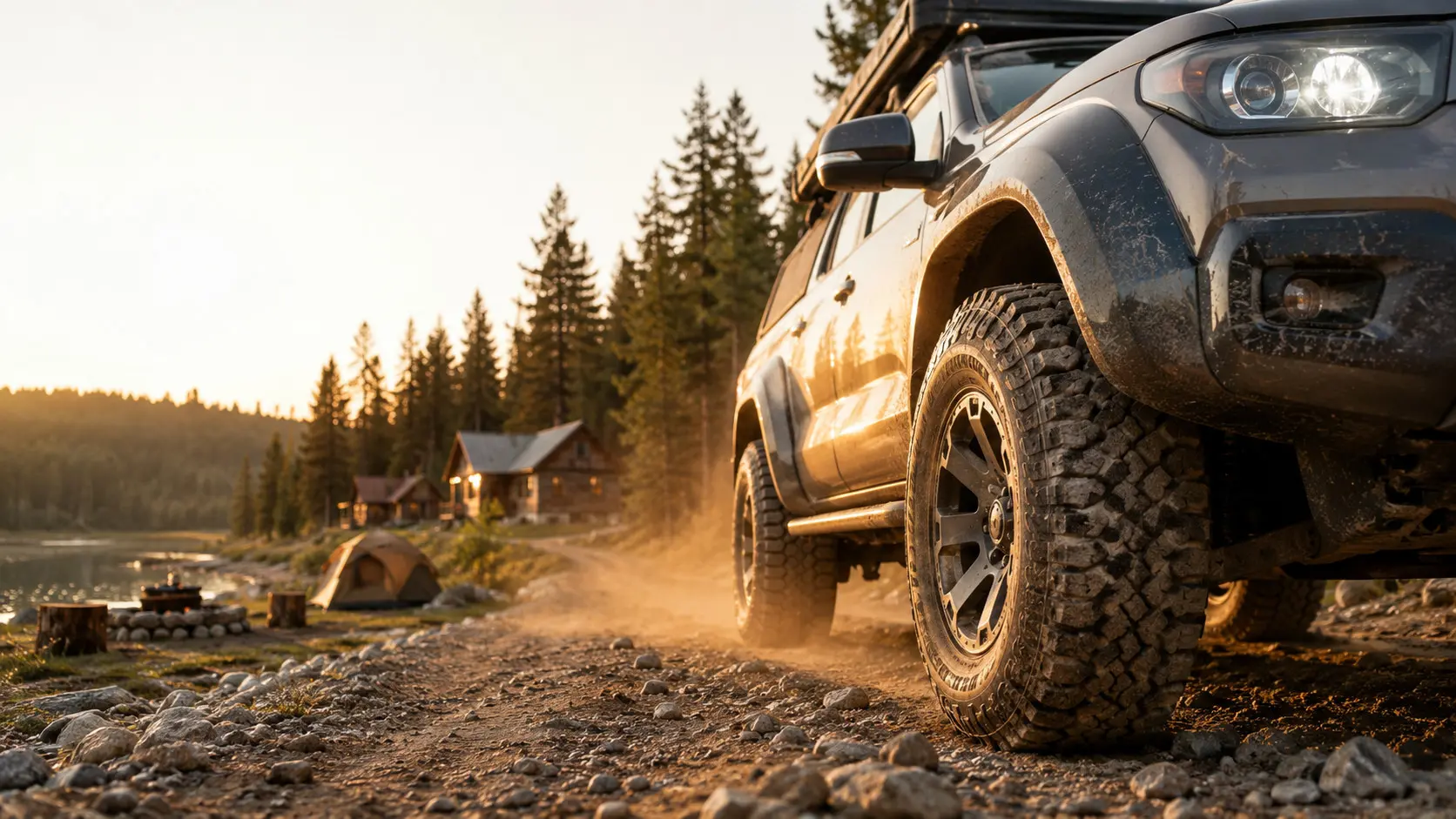
Heading Off-Grid? The Summit Trail Climber AT02 for Gravel, Cottage Roads, and Campsites
The road to a Canadian cottage, trailhead, fishing spot, or backcountry campsite is rarely as smooth as the highway that leads there. Loose gravel, washboard surfaces, potholes, sharp stones, standing water, muddy shoulders, and steep access roads can expose the limitations of an ordinary highway tire.
The Summit Trail Climber AT02 is an all-terrain tire designed for pickup trucks and SUVs that regularly move between paved roads and rougher surfaces. Its tread design, reinforced shoulders, deep tread, and winter-rated Three-Peak Mountain Snowflake certification make it a practical option for drivers who want more off-pavement capability without moving to a highly aggressive mud-terrain tire.
That does not make the AT02 an unlimited off-road tire. Vehicle capability, tire size, load, weather, driver technique, and road conditions still determine how far you can safely travel. However, for the typical Canadian mix of highways, gravel concessions, cottage lanes, forestry roads, and maintained campground routes, it offers a useful balance of traction, durability, and everyday comfort.
What Is the Summit Trail Climber AT02?
The Summit Trail Climber AT02 is an all-terrain tire for trucks and SUVs that need dependable performance on both paved roads and loose or uneven surfaces. It sits between a highway-terrain tire and a more aggressive mud-terrain tire.
Summit describes the AT02 as suitable for daily roads, highways, and trails. The manufacturer lists a wide tread footprint, reinforced shoulders, scalloped shoulder blocks, sidewall biters, four circumferential grooves, and lateral shoulder channels among its primary features. It also carries the Three-Peak Mountain Snowflake symbol and is offered with a 50,000-mile limited treadwear warranty, equivalent to approximately 80,000 kilometres. Warranty eligibility and terms should always be confirmed for the specific tire, seller, and Canadian purchase. :contentReference[oaicite:0]{index=0}
Where the AT02 fits in the tire market
| Tire category | Best suited to | Typical compromise |
|---|---|---|
| Highway-terrain | Mostly paved commuting, highway travel, light gravel use | Less traction and protection on loose or rough roads |
| All-terrain | Mixed pavement, gravel, cottage roads, campsites, light trails | Potentially more noise and rolling resistance than a highway tire |
| Rugged-terrain | Frequent rough trails, deeper mud, rocks, work sites | Heavier construction and a firmer or noisier highway ride |
| Mud-terrain | Serious off-road travel, deep mud, highly uneven terrain | More noise, faster irregular wear, and reduced on-road refinement |
The AT02 occupies the all-terrain middle ground. It is intended for drivers who need greater loose-surface traction than a conventional highway tire but still spend substantial time commuting, running errands, or travelling at highway speeds.
Why the AT02 Makes Sense for Gravel Roads
The AT02 is well matched to gravel because its open tread, broad footprint, and reinforced shoulder area are designed to maintain contact and traction on loose surfaces.
Gravel roads behave differently from pavement. The stones beneath the tire can move, reducing the amount of stable grip available for braking, steering, and acceleration. A tire that feels precise on dry asphalt may feel less settled once it reaches deep gravel or a freshly graded road.
A wide tread footprint helps distribute pressure
The manufacturer identifies the AT02’s wide tread footprint and reinforced shoulders as features intended to distribute pressure more evenly. On gravel, a stable footprint can help the vehicle feel more predictable when the surface changes between hard-packed tracks and loose stone.
Even pressure distribution may also support more consistent wear, provided the tires are correctly inflated, rotated, aligned, and matched to the vehicle.
Scalloped shoulders provide additional biting edges
The AT02 uses functional scalloped shoulders, deep tread depths, and sidewall biters. These features add edges around the outer tread area, where a tire often needs extra traction when climbing out of ruts, crossing a soft shoulder, or turning on loose ground.
Shoulder traction can be especially useful on:
- Freshly graded gravel roads
- Loose campground entrances
- Steep cottage driveways
- Rutted forestry roads
- Gravel boat-launch approaches
- Soft roadside pullouts
Deeper tread offers room to work on loose surfaces
The manufacturer’s product sheet lists 13/32-inch original tread depth for many passenger-metric sizes and 16/32-inch for numerous LT and flotation sizes. Actual specifications vary by size. Deeper tread and open voids allow the tire to engage loose material more effectively than a shallow, closely packed highway tread. :contentReference[oaicite:1]{index=1}
Expert tip: More aggressive tread can improve loose-surface capability, but it cannot overcome excessive speed. Slow down before entering a gravel corner, leave additional braking distance, and make steering inputs gradually.
How the AT02 Handles Cottage Roads
The AT02 is a practical cottage-road tire because it is designed to manage the uneven surfaces, water, loose material, and changing conditions commonly found beyond maintained pavement.
A cottage route can include several different surfaces in a single trip. You may leave the highway, travel along hard-packed gravel, cross a washed-out section, climb a rocky lane, and finish on damp soil beneath tree cover.
Washboard and broken surfaces
Washboard roads create repeated impacts that can unsettle the suspension and reduce tire contact with the ground. An all-terrain tread can provide useful traction, but driving technique remains critical.
Reduce speed until the vehicle feels controlled. Avoid sudden braking or sharp steering, particularly when the road curves or slopes toward a ditch. If the steering begins to feel light or the rear of the vehicle starts moving sideways, slow down smoothly rather than making an abrupt correction.
Potholes and exposed rocks
Reinforced shoulder construction may provide greater durability than a light-duty touring design, but no tire is puncture-proof. A sharp rock can still cut a tread block, damage a sidewall, or bend a wheel.
When approaching a rough section:
- Reduce speed before reaching the obstacle.
- Keep enough distance to see the full road surface.
- Avoid striking rocks with the sidewall.
- Do not make sudden steering movements around deep potholes.
- Inspect the tires after any hard impact.
Water evacuation on wet access roads
The AT02 has four circumferential grooves and lateral shoulder channels designed to move water away from the footprint. That is useful during heavy summer rain and on cottage roads where water collects in wheel tracks. :contentReference[oaicite:2]{index=2}
Water depth, mud, speed, tread depth, and road shape still affect traction. Never assume that a water-filled rut is shallow. Water can hide rocks, holes, washouts, and damaged road edges.
Is the AT02 Suitable for Campsites and Campground Access?
The AT02 is well suited to maintained campgrounds and moderate backroad access, especially when the route includes gravel, dirt, grass, shallow mud, or uneven parking areas.
Many campsites do not require a dedicated off-road vehicle, but they can still challenge ordinary tires. A heavy SUV loaded with coolers, tents, water, bicycles, and passengers may need to climb a loose entrance road or park on wet grass.
Loose campground surfaces
The tire’s shoulder blocks and all-terrain tread can help when pulling away from loose gravel or crossing an unpaved site. Use gentle throttle to avoid spinning the tires and digging into the surface.
Wet grass and shallow mud
The AT02 should offer more useful traction than a typical highway tire in light mud and wet grass. However, it is not a dedicated mud-terrain tire. Thick clay, deep ruts, standing water, or a saturated field can overwhelm an all-terrain pattern.
Before entering a soft section, consider:
- Whether another vehicle has already created deep ruts
- Whether the ground slopes downhill toward water
- Whether there is space to turn around
- Whether recovery equipment is available
- Whether the road will become worse after additional rain
Loaded vehicles and camping gear
Camping equipment can add more weight than expected. Water containers, firewood, coolers, rooftop cargo, bicycles, recovery equipment, and passengers all contribute to the vehicle’s gross weight.
Check the vehicle’s payload rating, gross vehicle weight rating, axle ratings, and recommended cold tire pressure. The AT02 is available in passenger-metric, XL, LT, and flotation configurations, but the correct choice depends on the vehicle manufacturer’s specifications and the load being carried.
How the AT02 Performs on the Highway
The AT02 is designed to remain usable and relatively refined on pavement, making it more suitable for mixed driving than a highly aggressive off-road tire.
Most cottage and camping trips involve far more highway kilometres than trail kilometres. A tire that performs well only after the pavement ends may be tiring or inefficient during the rest of the journey.
Ride comfort and road noise
All-terrain tread blocks usually create more sound than closely spaced highway tread. Summit positions the AT02 as a smooth and quiet all-terrain model, although perceived noise depends on the tire size, vehicle insulation, road surface, inflation pressure, tread wear, and wheel alignment. :contentReference[oaicite:3]{index=3}
Drivers moving from a passenger-oriented highway tire may notice additional tread sound. Drivers moving from a mud-terrain tire will generally expect a more restrained highway experience.
Steering response
Deep tread blocks can feel less immediate than a performance-oriented street tire, particularly when the tires are new. That does not necessarily indicate a problem. However, wandering, pulling, vibration, or excessive steering correction should be inspected rather than dismissed as normal all-terrain behaviour.
Fuel consumption
An all-terrain tire may have greater weight and rolling resistance than a comparable highway tire. Actual fuel consumption depends on tire size, construction, pressure, vehicle aerodynamics, speed, load, alignment, temperature, and driving habits.
Choosing an unnecessarily large or heavy LT tire can affect acceleration, braking feel, ride comfort, and fuel use. Select the construction your vehicle and workload require rather than assuming the heaviest option is automatically the best.
Can the AT02 Be Used in Canadian Winter Conditions?
The AT02 carries the Three-Peak Mountain Snowflake symbol, but drivers should still choose winter equipment according to local climate, road conditions, and provincial requirements.
The 3PMSF symbol indicates that the tire meets a standardized performance threshold in medium-packed snow. The Summit product sheet lists the AT02 as 3PMSF-certified. :contentReference[oaicite:4]{index=4}
This certification is meaningful for shoulder-season trips, unexpected mountain snow, and regions with moderate winter conditions. It does not mean that an all-terrain tire will match every capability of a dedicated winter tire, particularly on glare ice, freezing rain, or consistently severe cold-weather roads.
Québec winter tire requirements
Most motor vehicles registered in Québec must be equipped with compliant winter tires from December 1 through March 15. Drivers should confirm that the exact tire and size meet Québec’s requirements rather than relying only on a retailer’s general category description. :contentReference[oaicite:5]{index=5}
British Columbia winter routes
Winter tire or chain requirements apply on most designated British Columbia routes from October 1 to April 30, although some routes have an earlier end date. Posted signs and current provincial guidance take priority, especially when travelling to mountain campsites, ski areas, or remote communities. :contentReference[oaicite:6]{index=6}
When dedicated winter tires may be the better choice
Consider dedicated winter tires when your driving regularly includes:
- Compact snow and ice for several months
- Unplowed rural or cottage roads
- Frequent freezing rain
- Mountain passes and steep winter grades
- Early-morning travel before roads are treated
- Remote routes where recovery may be delayed
Transport Canada recommends installing winter tires as a set of four and matching tire type, size, speed rating, load index, tread pattern, and construction to support predictable vehicle stability. :contentReference[oaicite:7]{index=7}
AT02 Versus Highway-Terrain and Mud-Terrain Tires
The AT02 is the better compromise when a vehicle spends substantial time on pavement but regularly encounters gravel, dirt, and moderately rough access roads.
| Driving consideration | Highway-terrain tire | Summit Trail Climber AT02 | Mud-terrain tire |
|---|---|---|---|
| Highway comfort | Typically strongest | Balanced for mixed use | Usually the firmest and noisiest |
| Gravel traction | Suitable for occasional light use | Designed for regular gravel travel | Strong, but often more aggressive than necessary |
| Cottage roads | Best on maintained lanes | Well suited to varied access roads | Best when routes are consistently severe |
| Shallow mud | Limited | Moderate capability | Strong capability |
| Deep mud | Poor choice | May become overwhelmed | Purpose-built for these conditions |
| Fuel efficiency | Typically better | Moderate compromise | Typically the greatest compromise |
| Visual appearance | Subtle | Rugged without being extreme | Highly aggressive |
A highway-terrain tire remains sensible for drivers who visit a well-maintained cottage road only a few times per year. A mud-terrain tire makes more sense for frequent deep mud, severe work sites, or technical off-road use. The AT02 is aimed at the large group between those two extremes.
How to Select the Correct AT02 Size and Load Rating
The correct AT02 is the size and construction that meet the vehicle manufacturer’s requirements for dimensions, load capacity, speed rating, wheel fitment, and intended use.
The AT02 is available in a broad range of passenger-metric, XL, LT, and flotation sizes. The manufacturer’s current product sheet includes fitments for 15-, 16-, 17-, 18-, 20-, and 22-inch wheels, although Canadian stock can change. :contentReference[oaicite:8]{index=8}
Start with the door placard
Check the tire and loading information label on the driver’s door jamb. It identifies the original tire size and recommended cold inflation pressure for the factory configuration.
Do not use the maximum pressure printed on the tire sidewall as the everyday pressure unless the vehicle or tire application specifically requires it. The sidewall figure identifies a tire limit associated with its rated load, not a universal vehicle setting.
Understand passenger, XL, and LT construction
- Passenger-metric tires: Often provide a lighter and more compliant ride for SUVs and light-duty pickups.
- XL tires: Provide additional load capacity within a passenger-tire construction.
- LT tires: Intended for light-truck service and heavier loads, with inflation and load requirements that differ from passenger tires.
- Flotation sizes: Use inch-based sizing such as 31X10.50R15 and require careful wheel, suspension, and body-clearance verification.
Moving from a passenger tire to an LT tire can change the pressure required to carry the same vehicle load. A qualified tire professional should calculate the correct replacement pressure rather than copying the original number or inflating every LT tire to its maximum.
Avoid casual oversizing
A larger tire can affect:
- Wheel-well and suspension clearance
- Speedometer and odometer accuracy
- Anti-lock braking and stability-control operation
- Effective gearing and acceleration
- Braking response
- Spare-tire compatibility
- Payload and towing behaviour
Confirm fitment before ordering, especially when the vehicle has aftermarket wheels, a levelling kit, suspension modifications, or non-standard offsets.
Should You Air Down the AT02 on Gravel or Trails?
Most cottage-road and campground trips should begin at the vehicle manufacturer’s recommended cold pressure, not at an improvised lower setting.
Reducing pressure can sometimes enlarge the contact area and soften the ride on specific off-road surfaces. However, excessive deflation increases sidewall flex, heat generation, rim-damage risk, steering delay, and the possibility of unseating a tire from the wheel.
Do not lower pressure merely because a road is unpaved. Highway-speed travel on an underinflated tire can generate damaging heat.
Drivers considering intentional pressure reduction for low-speed off-road use should have:
- A pressure recommendation appropriate for the vehicle, tire, load, and terrain
- An accurate tire gauge
- A suitable air compressor
- A plan to reinflate before returning to normal road speeds
- Sufficient sidewall and wheel clearance
- An understanding of TPMS warnings and vehicle handling changes
Expert tip: Never release air from a hot tire to make it match the vehicle’s cold-pressure specification. Pressure normally rises as the tire warms during driving.
Pre-Trip Tire Checklist for Cottage and Camping Travel
A five-minute tire inspection can identify many problems before the vehicle reaches a remote road without convenient repair service.
- Check cold tire pressure. Measure all four tires and the spare before driving.
- Inspect the tread. Look for cuts, embedded stones, missing tread pieces, exposed cords, or unusual wear.
- Inspect both sidewalls. Check for bulges, cracks, abrasions, punctures, and impact damage.
- Confirm tread depth. Measure at several points and watch for uneven shoulder or centre wear.
- Verify the load. Account for passengers, water, food, firewood, rooftop cargo, bikes, and towing equipment.
- Check the spare. Confirm that it is inflated, accessible, and compatible with the vehicle.
- Pack the correct tools. Carry the wheel-lock key, jack, lug wrench, pressure gauge, and approved recovery equipment.
- Review the route. Check weather, closures, wildfire restrictions, flooding, and road reports where available.
- Confirm towing equipment. Inspect trailer tires, hitch components, safety chains, lights, and brakes separately.
- Drive for the surface. Reduce speed before gravel, standing water, washboard, or blind corners.
How to Maintain the AT02 After an Off-Pavement Trip
Post-trip inspection, pressure checks, rotation, and alignment service help protect tread life after repeated gravel or cottage-road travel.
Remove trapped stones carefully
Small stones may become lodged in an all-terrain tread. Remove accessible debris when the vehicle is safely parked and the tires are cool. Do not use a tool in a way that cuts the rubber or damages the tread.
Look for cuts and impact marks
Examine the tread face and visible sidewalls after rocky routes. A small surface scuff may be cosmetic, but a bulge, exposed cord, deep cut, vibration, pressure loss, or impact mark should be evaluated promptly.
Monitor pressure over the next several days
A slow puncture may not be obvious immediately. Recheck cold pressure after travelling on sharp gravel or after any noticeable impact.
Rotate at the recommended interval
All-terrain tires can develop irregular wear if they remain in the same wheel positions for too long. Follow the vehicle and tire manufacturer’s rotation guidance, adjusting the schedule when towing, carrying heavy loads, or travelling extensively on rough roads.
Check alignment when wear becomes uneven
Feathered tread, rapid shoulder wear, steering pull, or an off-centre steering wheel can indicate an alignment or suspension issue. Potholes and repeated rough-road impacts can contribute to these problems.
Who Should Consider the Summit Trail Climber AT02?
The AT02 is most appropriate for truck and SUV drivers who need regular gravel-road capability while preserving reasonable highway comfort and year-round versatility.
It may be a strong match for:
- Cottage owners travelling on unpaved access roads
- Campers using provincial, private, and backcountry campgrounds
- Anglers and hunters travelling on maintained forestry roads
- Rural drivers who regularly encounter gravel and mud
- Tradespeople moving between highways and job sites
- Drivers seeking a rugged appearance without a full mud-terrain design
- Truck and SUV owners who value 3PMSF certification for variable weather
Another tire category may be more suitable when:
- Nearly all driving occurs on paved urban roads
- Maximum highway quietness and fuel economy are the priorities
- The vehicle regularly enters deep mud or technical off-road terrain
- Severe ice performance is more important than year-round convenience
- The required size, load index, or speed rating is unavailable
Final Recommendation
The Summit Trail Climber AT02 is a sensible mixed-use option for Canadian drivers whose weekends begin on the highway and end beyond the pavement.
Its broad footprint, reinforced shoulders, scalloped tread edges, sidewall biters, water channels, deep tread, and 3PMSF certification address many of the conditions found on gravel roads, cottage lanes, campsites, rural properties, and moderate trails.
The AT02’s main advantage is balance. It provides more loose-surface capability than a typical highway tire without moving all the way to the noise, weight, and specialized behaviour of a mud-terrain tire.
Before buying, confirm the exact size, load index, speed rating, construction, wheel compatibility, warranty conditions, and intended inflation pressure. The right fitment matters as much as the tread pattern—especially when carrying camping equipment, towing a trailer, or travelling far from paved roads.
Frequently Asked Questions About the Summit Trail Climber AT02
Is the Summit Trail Climber AT02 an all-terrain tire?
Yes. The AT02 is an all-terrain tire designed for trucks and SUVs that travel on both paved and unpaved surfaces. It is positioned for mixed highway, gravel, dirt-road, and light-trail use.
Is the AT02 good for gravel roads?
Its wide footprint, deep tread, reinforced shoulders, and scalloped shoulder blocks make it a suitable choice for regular gravel-road driving. Drivers must still reduce speed and leave additional braking distance because gravel provides less stable grip than pavement.
Can the AT02 handle muddy cottage roads?
It can provide useful traction in shallow mud, soft shoulders, and damp access roads. It is not a dedicated mud-terrain tire, so deep clay, severe ruts, or saturated ground may exceed its intended capability.
Is the Summit Trail Climber AT02 3PMSF-rated?
Yes. Summit lists the AT02 with the Three-Peak Mountain Snowflake symbol. The symbol indicates that the tire meets a standardized traction threshold in medium-packed snow, but it does not guarantee the same ice performance as a dedicated winter tire.
Can I use the AT02 year-round in Canada?
That depends on your province, climate, routes, and driving conditions. Its 3PMSF rating supports winter versatility, but dedicated winter tires may remain the safer choice for persistent ice, severe cold, unplowed roads, and demanding mountain travel. Provincial regulations must also be followed.
Is the AT02 quiet on the highway?
Summit promotes the AT02 as a smooth and quiet all-terrain model. It may still produce more tread sound than a highway-terrain tire, particularly on coarse pavement or in larger LT sizes.
What is the AT02 treadwear warranty?
The manufacturer lists a 50,000-mile limited treadwear warranty, approximately 80,000 kilometres. Coverage can depend on the size, application, maintenance records, seller, and Canadian warranty terms, so review the applicable policy before purchase.
Should I choose an LT version of the AT02?
Choose an LT tire only when its construction, load capacity, and service characteristics are appropriate for your vehicle and workload. LT tires can be beneficial for heavier trucks, towing, and demanding service, but they may also add weight and require different inflation pressures.
Can I put a larger AT02 size on my truck or SUV?
Possibly, but clearance is only one consideration. Oversizing can affect gearing, speedometer readings, braking, electronic safety systems, wheel fitment, spare-tire compatibility, and load capacity. Confirm the complete fitment with a qualified professional.
How often should AT02 tires be rotated?
Follow the rotation interval provided by the vehicle and tire manufacturers. More frequent inspection may be appropriate for vehicles that tow, carry heavy loads, or spend substantial time on gravel and rough roads.
Do I need to lower AT02 tire pressure on gravel?
Not for ordinary gravel-road driving. Begin with the vehicle manufacturer’s recommended cold pressure. Intentional pressure reduction should be reserved for appropriate low-speed off-road situations and requires a safe, application-specific plan for reinflation.
Is the AT02 suitable for towing a camper or boat?
It may be suitable when the exact tire size, load index, construction, pressure, and vehicle ratings support the loaded combination. The trailer itself must also use tires approved for its application, load, and operating conditions.
Recommended Related Reading
- Winter Tires vs. All-Terrain Tires: Which Type Fits Your Canadian Driving?
- What Happens to Tires During Long Road Trips?
- How to Choose the Best Light-Truck Tires in Canada
- Towing a Boat or Camper: A Practical Trailer Tire Safety Guide
In stock & ready to ship
Find the tires you need, delivered from a warehouse near you