
Winter Tire Pressure Loss: Why PSI Drops in the Cold and How Often to Refill
Cold Canadian temperatures can cause tire pressure to drop overnight, affecting traction, handling, tire wear, and fuel efficiency. Learn why winter tire PSI decreases, how often to check and refill your tires, and how to maintain the correct pressure throughout the winter driving season.
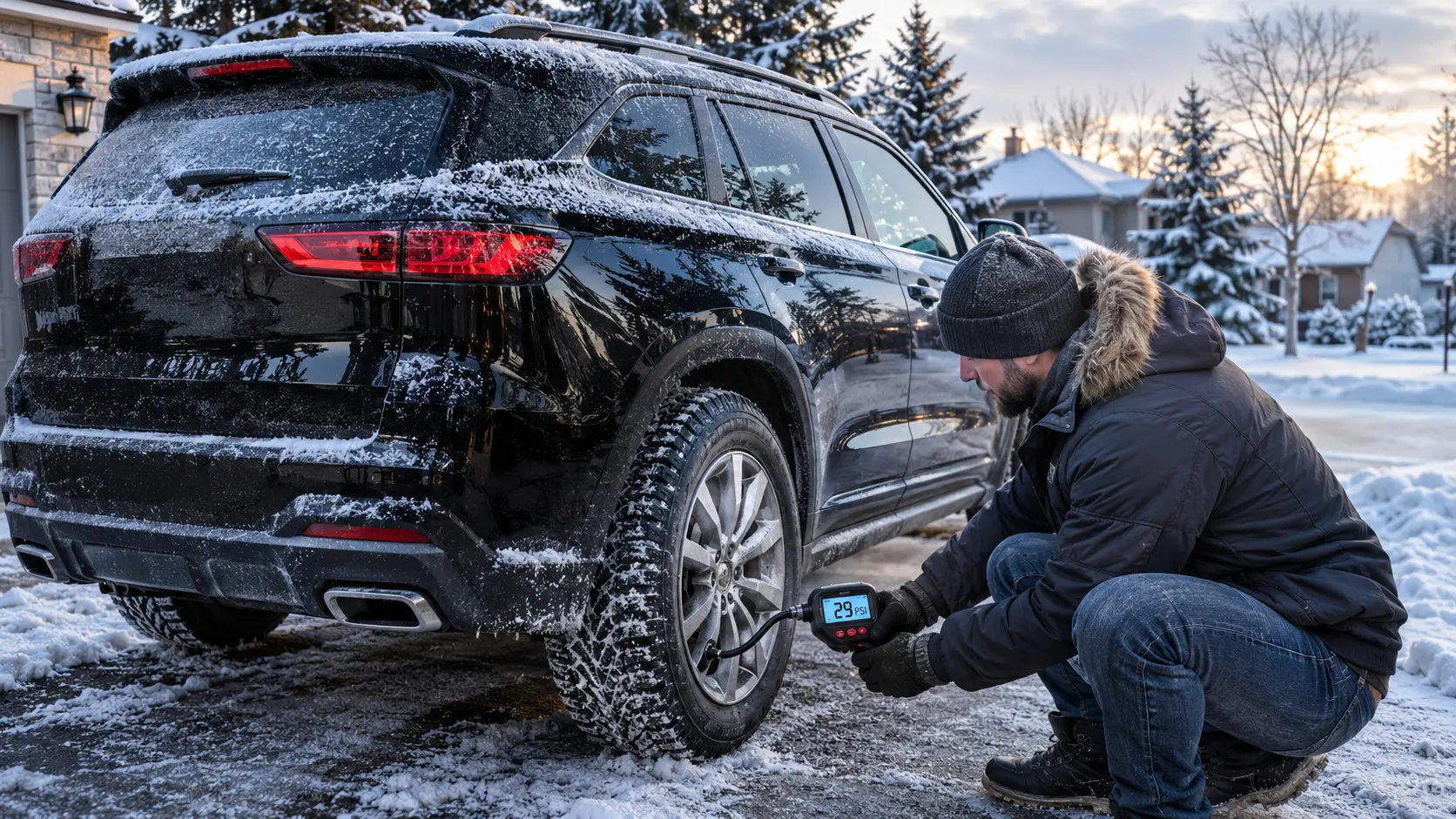
Winter Tire Pressure Loss: Why PSI Drops in the Cold and How Often to Refill
When Canadian temperatures drop below freezing, your tire pressure often drops with them. You might notice your tire pressure monitoring system (TPMS) warning light on a frosty morning, even though your tires appeared perfectly fine the day before.
This is a normal consequence of colder air temperatures, but it is not something drivers should ignore. Maintaining the correct winter tire pressure is essential for predictable handling, effective braking, even tread wear, and safe winter driving.
Whether you drive through Ontario snowstorms, Quebec’s freezing temperatures, Alberta cold snaps, or British Columbia’s mountain highways, understanding how cold weather affects tire pressure can help you avoid unnecessary tire damage and unexpected pressure warnings.
Quick answer: Tire pressure typically decreases by approximately 1–2 PSI for every 10°C drop in temperature, depending on the tire’s starting pressure and conditions. Check tire pressure at least once a month, preferably every two weeks during periods of significant winter temperature changes, and whenever the TPMS warning light appears. Inflate your tires to the vehicle manufacturer’s recommended cold tire pressure, not the maximum PSI printed on the tire sidewall.
Why Does Tire Pressure Drop in Cold Weather?
Tire pressure drops in cold weather because the air inside a tire becomes cooler, reducing the pressure it exerts against the tire’s inner surfaces. This is a predictable physical process rather than necessarily a sign of a leak.
As temperatures decrease, air molecules move more slowly. Because a tire’s internal volume remains relatively stable, the pressure inside the tire decreases as well.
This relationship is described by the ideal gas law, which explains how gas pressure, temperature, and volume are connected.
How Much PSI Do Tires Lose When Temperatures Drop?
A useful winter maintenance guideline is that tires can lose approximately 1–2 PSI for every 10°C decrease in temperature.
The exact pressure change depends on the initial tire pressure, the actual temperature difference, and how much the tire’s internal volume changes.
For example, a tire inflated to 35 PSI at 20°C could read approximately 30 PSI after cooling to -20°C, even without an air leak.
| Temperature Change | Approximate Pressure Loss | What Drivers May Notice |
|---|---|---|
| 10°C decrease | 1–2 PSI | Small pressure reduction |
| 20°C decrease | 2–3 PSI | Noticeable reduction on a pressure gauge |
| 30°C decrease | 3–4 PSI | Potential TPMS warning |
| 40°C decrease | 4–6 PSI | Significant underinflation risk |
Note: These are approximate values for typical passenger-vehicle tire pressures, not guaranteed pressure changes. The actual PSI loss depends on the starting pressure and temperature.
Why Tire Pressure Can Drop Overnight
Overnight temperature changes are particularly important during Canadian winters.
Imagine parking your vehicle after an afternoon drive when the outdoor temperature is -2°C. By the following morning, temperatures have fallen to -22°C.
That 20°C temperature decrease can reduce tire pressure by roughly 2–3 PSI. If the tires were already slightly underinflated, the additional drop may activate the TPMS warning light.
This explains why a tire pressure warning sometimes appears on a cold morning and disappears after driving.
Important: A warning light that disappears after the tires warm up does not prove the tires are correctly inflated. Check their pressure when cold and adjust it if necessary.
What Should Winter Tire Pressure Be?
The correct winter tire pressure is the cold inflation pressure specified by your vehicle manufacturer, unless the manufacturer provides different instructions for your tire size or driving conditions.
There is no universal winter tire PSI suitable for every passenger car, SUV, pickup truck, or electric vehicle.
Where to Find Your Vehicle’s Recommended PSI
Most Canadian vehicles display the recommended tire pressure on a tire information placard located on the driver’s door jamb.
You can also consult the owner’s manual.
The placard typically provides:
- Recommended front tire pressure
- Recommended rear tire pressure
- Original equipment tire sizes
- Vehicle load information
- Additional pressure instructions, when applicable
Front and rear tire pressures may differ, so check both specifications before inflating your tires.
Typical Tire Pressure Examples by Vehicle Type
The following ranges are illustrative only. They are not substitutes for the pressure specified on your vehicle’s tire placard.
| Vehicle Type | Illustrative Cold Tire Pressure | Important Consideration |
|---|---|---|
| Compact car | 30–35 PSI | Use the vehicle placard |
| Midsize sedan | 32–36 PSI | Front and rear specifications may differ |
| Crossover or SUV | 32–38 PSI | Pressure depends on vehicle and tire configuration |
| Pickup truck | 35 PSI or higher | Heavy-duty and load-rated tires may require substantially higher pressures |
| Electric vehicle | 35–45 PSI | Follow the manufacturer’s specifications for the vehicle and tire size |
These examples demonstrate why drivers should never assume that a pressure suitable for one vehicle will work for another.
Should You Inflate Winter Tires Above the Recommended PSI?
Generally, no. Drivers should not automatically add extra pressure simply because temperatures are below freezing.
The manufacturer’s cold inflation recommendation already represents the intended pressure when the tires are cold, including during winter conditions.
Some manufacturers provide specific adjustments for extremely low temperatures, winter tire configurations, or sustained high-speed operation. Follow those instructions when applicable.
TireWarehouse Expert Tip: Do not confuse the maximum inflation pressure moulded into a tire’s sidewall with the recommended operating pressure for your vehicle. The sidewall value is a tire limit, not a universal inflation target.
How Often Should You Check and Refill Tire Pressure in Winter?
Check winter tire pressure at least once a month and before long trips. During periods of rapid temperature changes, checking every two weeks is a sensible precaution. Refill whenever a cold-pressure measurement is below the manufacturer’s recommended level.
You do not need to add air according to a fixed calendar schedule if the tires are already at the correct pressure.
Instead, use regular measurements to determine when inflation is necessary.
Recommended Winter Tire Pressure Check Schedule
| Situation | Recommended Action |
|---|---|
| Normal winter driving | Check at least monthly |
| Rapid temperature fluctuations | Check approximately every two weeks |
| Major cold snap | Check after temperatures stabilize at the colder level |
| Before a winter road trip | Check all tires before departure |
| TPMS warning light appears | Check pressures promptly |
| After hitting a significant pothole | Inspect for damage and check pressure |
| One tire repeatedly loses pressure | Arrange a professional tire inspection |
Do You Need to Add Air Every Time the Temperature Drops?
Not necessarily. A small temperature-related pressure change does not automatically mean a tire requires immediate inflation.
However, if the cold pressure falls below the vehicle manufacturer’s recommended specification, add enough air to restore the correct pressure.
For example, if your vehicle requires 35 PSI and your cold tire pressure reads 31 PSI, you should restore it to 35 PSI.
If the tire already reads 35 PSI when cold, adding extra pressure because another cold night is forecast is generally unnecessary unless the manufacturer specifically instructs otherwise.
How to Check Winter Tire Pressure Correctly
The most accurate way to check winter tire pressure is to measure it before driving, when the tires are cold and have not been significantly heated by road use.
A reliable tire pressure gauge and a few minutes of maintenance are usually all you need.
Step-by-Step Winter Tire Pressure Check
- Park your vehicle: Ideally, leave the vehicle parked for at least three hours before measuring tire pressure.
- Find the recommended PSI: Read the tire information placard on the driver’s door jamb.
- Remove the valve cap: Keep it somewhere clean so it does not get lost in snow or slush.
- Attach the pressure gauge: Press it firmly onto the valve stem to obtain an accurate reading.
- Compare the reading: Check the measured pressure against the manufacturer’s cold inflation recommendation.
- Add or release air: Adjust the tire to the specified cold pressure.
- Recheck the reading: Confirm the final pressure using your gauge.
- Replace the valve cap: Make sure it is properly secured.
- Repeat for every tire: Check all four tires and the spare, if equipped.
When checking the spare tire, use its own specified pressure, which may be significantly higher than the pressure for the vehicle’s road tires.
What Counts as a Cold Tire?
A cold tire is generally one that has not been driven for at least three hours or has travelled only a very short distance at low speed.
Driving generates heat through tire flexing and road friction, increasing the pressure inside the tire.
If you check your tires immediately after highway driving, the readings may be several PSI higher than their cold inflation pressures.
Do not release air from a warm tire simply to make its pressure match the cold specification. Doing so can leave the tire underinflated after it cools.
What If You Must Drive to a Gas Station to Add Air?
If possible, measure your tire pressure at home while the tires are cold and record the readings before driving to an air compressor.
Use those readings to estimate the amount of air needed, taking into account that pressure may increase during the drive.
After adding air, check the tires again when they are fully cold and make any necessary final adjustments.
Some vehicle manufacturers provide specific instructions for adjusting pressure when tires are warm. Consult your owner’s manual for those procedures.
Why Driving With Low Winter Tire Pressure Is Dangerous
Underinflated winter tires can compromise vehicle stability, increase tire wear, and generate excessive heat. On snowy or icy Canadian roads, maintaining the correct inflation pressure is especially important.
1. Reduced Steering Response and Handling
When a tire is underinflated, its sidewalls flex more than intended.
Excessive flexing can reduce steering precision and make the vehicle feel less responsive during cornering or emergency manoeuvres.
Winter roads already present challenges such as black ice, compacted snow, slush, and uneven traction. Incorrect tire pressure can make maintaining control more difficult.
2. Less Predictable Braking Performance
Winter tires are engineered with specialized rubber compounds, tread patterns, and sipes to provide traction in cold conditions.
Incorrect inflation changes how the tire interacts with the road surface and can affect braking behaviour.
Actual stopping distance depends on numerous factors, including road conditions, tire design, tread depth, vehicle speed, and the effectiveness of the anti-lock braking system (ABS).
Maintaining the specified tire pressure helps the tire perform as its manufacturer intended.
3. Uneven and Premature Tire Wear
Underinflated tires often experience increased wear along their outer shoulders because of excessive sidewall flexing and changes in the contact patch.
Overinflation can contribute to increased wear near the centre of the tread.
Other problems, including incorrect wheel alignment, worn suspension components, and missed tire rotations, can also cause uneven tread wear.
4. Increased Fuel Consumption
Low tire pressure can increase rolling resistance, meaning the vehicle must use more energy to maintain its speed.
For gasoline-powered vehicles, this can increase fuel consumption.
For electric vehicles, additional rolling resistance can reduce driving efficiency and potentially affect range.
Winter temperatures already influence fuel economy and battery performance, making correct tire inflation a worthwhile maintenance habit.
5. Excessive Tire Heat and Structural Damage
Even in freezing weather, an underinflated tire can overheat internally while driving.
Excessive flexing generates heat inside the tire structure. Prolonged operation at significantly low pressure can damage internal components and increase the risk of tire failure.
This is particularly concerning during long highway trips, when tires operate continuously under load.
Safety Reminder: Winter tires do not eliminate the risks associated with incorrect tire pressure. Even high-quality tires carrying the Three-Peak Mountain Snowflake (3PMSF) symbol require proper inflation, adequate tread depth, and regular inspection.
Does Lower Tire Pressure Improve Traction on Snow and Ice?
Deliberately lowering tire pressure is not recommended for normal winter driving on public roads. Although reduced pressure can alter the tire’s contact patch, it does not reliably improve overall traction or safety on snow and ice.
Some drivers believe that reducing tire pressure creates a wider contact patch and therefore provides more grip.
However, winter traction depends on more than the size of the contact patch.
Important factors include:
- Winter tire rubber compound
- Tread pattern and siping
- Snow and ice conditions
- Tread depth
- Vehicle weight and load distribution
- Correct inflation pressure
- Vehicle speed and driving technique
Lowering pressure can also increase sidewall flexing, reduce steering precision, and potentially damage the tire.
Why Off-Road Tire Pressure Advice Does Not Apply to Winter Highways
Off-road drivers sometimes reduce tire pressure for specialized low-speed conditions such as deep sand or certain snow-covered trails.
Those techniques involve different equipment, speeds, surfaces, and operating requirements.
They should not be applied to ordinary winter driving on Canadian streets and highways.
For everyday driving, follow the vehicle manufacturer’s inflation recommendations.
Why Does the TPMS Warning Light Come On During Winter?
A tire pressure monitoring system warning often appears during winter because colder temperatures reduce tire pressure enough to trigger the system’s low-pressure threshold.
However, a warning can also indicate a puncture, valve leak, wheel-related issue, or TPMS malfunction.
How Tire Pressure Monitoring Systems Work
There are two main types of TPMS.
- Direct TPMS: Uses sensors associated with the wheels to measure tire pressure and transmit information to the vehicle.
- Indirect TPMS: Uses wheel-speed information and related calculations to identify changes consistent with underinflation.
Depending on the vehicle, the system may display individual tire pressures or simply illuminate a warning light.
Not all TPMS systems alert drivers at the same pressure threshold.
What to Do When the TPMS Light Comes On
- Reduce speed and assess whether the vehicle feels or handles abnormally.
- Stop in a safe location if you suspect a severely underinflated or damaged tire.
- Inspect the tires for visible damage or obvious deflation.
- Measure tire pressures with a reliable gauge.
- Inflate the tires to the vehicle manufacturer’s specified cold pressure when appropriate.
- Follow the owner’s manual if the system requires recalibration or resetting.
- Seek professional service if the warning remains active or returns repeatedly.
If a tire is visibly flat or severely underinflated, do not continue driving on it. Arrange appropriate roadside assistance or tire service.
Can You Ignore a TPMS Light If It Goes Away?
No. A warning that disappears after driving may simply mean the tires have warmed up and their pressure has increased temporarily.
The tires may still be underinflated when cold.
Always verify their actual pressure rather than relying on the warning light alone.
Normal Cold-Weather Pressure Loss vs. a Tire Leak
Normal cold-weather pressure loss usually affects several tires in a similar way. A persistent or unusually rapid loss in one tire may indicate a leak or another mechanical problem.
| Observation | Possible Explanation | Recommended Action |
|---|---|---|
| All four tires lose similar PSI after a cold snap | Temperature-related pressure reduction | Check and adjust cold pressures |
| One tire loses pressure much faster | Puncture, valve leak, or bead leak | Arrange a tire inspection |
| Pressure drops repeatedly after inflation | Possible ongoing air leak | Have the tire and wheel inspected |
| Pressure warning disappears after driving | Pressure increases as tires warm | Verify cold inflation pressure |
| Visible sidewall bulge or tire damage | Possible structural damage | Do not drive on the damaged tire |
Common Causes of Winter Tire Air Leaks
Winter conditions can reveal or worsen existing sealing problems.
Potential causes include:
- Nails or screws: Road debris can puncture the tread.
- Damaged valve stems: Age, impact damage, or deterioration can allow air to escape.
- Wheel corrosion: Corrosion around the bead seating area can interfere with the tire-to-wheel seal.
- Damaged wheel rims: Pothole impacts can bend or crack wheels.
- Improper tire mounting: Bead seating or installation problems can lead to slow leaks.
- Damaged TPMS components: Some sensor-related valve assemblies can develop leaks.
Road salt, moisture, freezing conditions, and repeated temperature changes can make winter an especially demanding season for wheels and valve components.
How Much Pressure Loss Is Too Much?
A tire that loses pressure repeatedly without a corresponding temperature decrease should be inspected.
For example, if one tire drops from 35 PSI to 29 PSI over several days while the other tires remain near their recommended pressure, a leak is a reasonable concern.
Do not simply keep adding air indefinitely. Have the tire inspected to identify the underlying problem.
Do Winter Tires Lose Air Faster Than All-Season Tires?
Winter tires do not inherently lose pressure faster than all-season or all-weather tires simply because they use winter-specific rubber compounds. Temperature changes affect the air inside all pneumatic tires.
However, winter tires are frequently exposed to colder conditions, which makes pressure reductions more noticeable.
Winter vs. All-Season vs. All-Weather Tire Pressure
| Tire Type | Cold-Weather Pressure Behaviour | Maintenance Recommendation |
|---|---|---|
| Winter tires | Pressure decreases as temperature falls | Check monthly and during cold snaps |
| All-season tires | Pressure decreases as temperature falls | Check monthly and during cold snaps |
| All-weather tires | Pressure decreases as temperature falls | Check monthly and during cold snaps |
The primary differences between these tire categories involve their intended operating conditions, tread designs, and rubber compounds rather than a fundamentally different response of the contained air to temperature.
Winter tires generally use compounds designed to remain flexible at low temperatures, while qualifying all-weather tires are designed for year-round use, including certain winter conditions.
All-season tires vary in their cold-weather capabilities and are not necessarily suitable substitutes for dedicated winter tires in severe winter conditions.
How Canadian Winter Conditions Affect Tire Pressure
Canadian winter driving presents different tire pressure challenges depending on local temperatures, weather patterns, and road conditions.
Drivers should pay particular attention to rapid temperature changes rather than relying on the calendar alone.
Ontario: Freeze-Thaw Cycles and Winter Road Trips
Ontario drivers often experience temperatures that fluctuate above and below freezing.
These changes can cause tire pressure to rise and fall throughout the season.
Before travelling on major routes such as Highway 401 or Highway 400, check cold tire pressures, especially if a significant temperature drop has occurred.
Quebec: Extended Cold and Winter Tire Requirements
Quebec’s long winter season makes regular tire pressure maintenance particularly important.
Under Quebec’s winter tire rules, most passenger vehicles registered in the province must be equipped with compliant winter tires from December 1 through March 15, subject to applicable exceptions.
However, complying with winter tire regulations does not eliminate the need to maintain correct inflation pressure.
Even properly certified winter tires can become underinflated during prolonged periods of extreme cold.
Alberta, Saskatchewan, and Manitoba: Extreme Cold Snaps
Prairie provinces can experience substantial temperature changes during winter.
A vehicle parked outdoors during a severe cold snap may show noticeably lower tire pressure than it did during milder weather.
Drivers should check pressures after major temperature changes and before longer highway journeys.
British Columbia: Mountain Roads and Changing Elevations
British Columbia drivers may encounter changing temperatures and elevations during trips between coastal communities and mountain regions.
Many designated provincial routes have seasonal winter tire or chain requirements, and drivers should verify the rules for their specific route and travel dates.
Changes in elevation can also influence gauge pressure because atmospheric pressure changes with altitude.
Before a mountain trip, check tire inflation, inspect tread condition, and confirm that your tires meet applicable route requirements.
Does Tire Pressure Increase When Winter Tires Warm Up?
Yes. Tire pressure normally increases as the tires warm during driving because the air inside them becomes warmer.
This is why tire manufacturers and vehicle manufacturers emphasize cold inflation pressure.
Cold Tire Pressure vs. Warm Tire Pressure
Suppose your vehicle requires 35 PSI when cold.
You measure 35 PSI before leaving home. After driving on the highway, the tires warm up and the gauge may show 38–39 PSI.
That increase can be normal and does not automatically indicate overinflation.
Do not release air simply because a warm tire measures above the specified cold pressure.
What Happens When Temperatures Rise Again?
When outdoor temperatures increase, tire pressure generally increases as well.
For example, a tire adjusted to the recommended cold pressure during a severe cold snap may read higher during a subsequent warm spell.
If the tires are above the recommended pressure when measured cold, adjust them according to the vehicle manufacturer’s instructions.
This is another reason regular measurements are more reliable than automatically adding air throughout the winter.
How to Prevent Winter Tire Pressure Problems
You cannot prevent normal temperature-related pressure changes, but consistent maintenance can reduce the likelihood of prolonged underinflation, unexpected warnings, and avoidable tire damage.
Winter Tire Pressure Maintenance Checklist
- Check tire pressure at least once every month.
- Increase monitoring during rapid temperature changes.
- Measure pressure before driving whenever possible.
- Use a reliable tire pressure gauge.
- Follow the vehicle manufacturer’s recommended cold PSI.
- Check front and rear tire specifications separately.
- Inspect valve stems and valve caps.
- Look for visible tread and sidewall damage.
- Monitor for uneven tire wear.
- Check pressure before long winter road trips.
- Investigate recurring TPMS warnings.
- Have persistent pressure loss professionally diagnosed.
Choose a Reliable Tire Pressure Gauge
A digital or quality analogue tire pressure gauge is a useful addition to a winter emergency kit.
Choose a gauge with a suitable measurement range, readable display, and reliable performance in cold temperatures.
Keep it clean and protected from moisture, and follow its manufacturer’s storage and operating instructions.
Inspect Your Tires During Seasonal Changeovers
When installing winter tires, ask the tire technician to inspect the tires, wheels, and valve components.
A seasonal inspection can help identify:
- Uneven tread wear
- Embedded objects
- Cracks or sidewall damage
- Wheel corrosion
- Valve stem deterioration
- Potential bead sealing problems
- Incorrect tire sizing or load specifications
Proper mounting, balancing, and inflation are important parts of winter tire installation.
Consider Your Winter Tire Storage Conditions
Stored tires can experience pressure changes as temperatures fluctuate.
If you store a complete winter tire and wheel assembly, check its condition and inflation pressure before reinstalling it.
Do not assume that tires stored at the correct pressure several months earlier will still have the correct pressure when installed.
Winter Tire Pressure Mistakes to Avoid
The most common winter tire pressure mistakes involve using the wrong PSI target, relying only on dashboard warnings, or adjusting pressure while tires are warm.
Mistake 1: Using the Maximum PSI on the Tire Sidewall
The maximum pressure marked on the tire is not the same as the vehicle manufacturer’s recommended operating pressure.
Use the tire placard or approved manufacturer guidance.
Mistake 2: Waiting for the TPMS Light Before Checking Pressure
A TPMS warning is not a replacement for routine pressure checks.
Some systems may not detect smaller pressure reductions, and indirect systems may not display actual PSI readings.
Mistake 3: Lowering PSI for Better Snow Traction
Reducing tire pressure below the recommended specification can negatively affect handling and tire durability.
For normal public-road driving, maintain the manufacturer’s specified pressure.
Mistake 4: Releasing Air After Highway Driving
Warm tires naturally show higher pressure readings.
Releasing air while they are warm can result in underinflation when they cool.
Mistake 5: Ignoring One Tire That Repeatedly Loses Air
A single tire with persistent pressure loss may have a puncture, valve problem, wheel damage, or bead leak.
Professional inspection is more appropriate than repeatedly topping it up without diagnosis.
Mistake 6: Forgetting the Spare Tire
If your vehicle has an inflatable spare, check its pressure according to the owner’s manual.
Compact temporary spare tires often require substantially different inflation pressures from standard road tires.
Frequently Asked Questions About Winter Tire Pressure Loss
1. How much PSI do tires lose in cold weather?
Tire pressure commonly decreases by approximately 1–2 PSI for every 10°C temperature drop. The exact amount depends on starting pressure, temperature, and tire characteristics. A large overnight temperature decrease can therefore produce a noticeable reduction even when the tire has no leak.
2. How often should I put air in my winter tires?
Check pressure at least monthly, and preferably every two weeks during periods of significant temperature fluctuations. Add air whenever a cold tire measures below the vehicle manufacturer’s recommended pressure. There is no need to refill tires that are already correctly inflated.
3. Is 30 PSI too low for winter tires?
It depends on the vehicle. If the manufacturer specifies 30 PSI, that may be correct. If the specified cold pressure is 35 PSI, a reading of 30 PSI indicates underinflation. Always compare the measurement with the tire information placard.
4. Should I add 5 PSI to my tires in winter?
Not automatically. Most drivers should use the vehicle manufacturer’s recommended cold tire pressure rather than adding a fixed amount. Follow any special cold-weather inflation instructions provided in the owner’s manual.
5. Why is my tire pressure light on when it is freezing?
Cold temperatures reduce tire pressure and can cause the TPMS to detect underinflation. However, the warning may also indicate a leak or other problem. Measure all tire pressures and inspect for damage rather than assuming the weather is the only cause.
6. Will my tire pressure return to normal when it gets warmer?
Tire pressure generally increases as the air inside the tire warms. However, warming does not replace air that has escaped through normal permeation or a leak. Always verify the actual cold pressure before deciding whether an adjustment is needed.
7. Do winter tires need different PSI than summer tires?
Not necessarily. When the winter tires are an approved size and specification for the vehicle, the manufacturer’s recommended pressure is generally the starting point. Some vehicles specify different pressures for alternative tire sizes, winter tire packages, or load conditions, so consult the owner’s manual.
8. Can I drive with my tire pressure light on in winter?
A warning light should be investigated promptly. If the vehicle feels unstable, a tire appears flat, or significant damage is visible, stop safely and arrange assistance. If there are no signs of severe damage, check the pressures as soon as safely possible and follow the vehicle manufacturer’s instructions.
9. Is it better to check tire pressure in the morning?
Morning is often a convenient time because the vehicle has been parked overnight and the tires are cold. The important factor is measuring before driving or after sufficient time for the tires to cool, rather than the exact time of day.
10. Does nitrogen prevent winter tire pressure loss?
No. Nitrogen-filled tires still experience pressure changes as temperatures rise and fall. Nitrogen may offer certain benefits in specialized applications, but it does not eliminate the need for routine tire pressure checks.
11. Why does only one tire lose pressure during winter?
If one tire repeatedly loses substantially more pressure than the others, it may have a puncture, leaking valve stem, damaged wheel, or bead sealing issue. Temperature changes generally affect all tires exposed to similar conditions, so an isolated recurring loss deserves inspection.
12. Can overinflated winter tires be dangerous?
Yes. Excessive inflation can change the contact patch, affect ride comfort and handling, and contribute to uneven tread wear. Maintain the vehicle manufacturer’s specified cold pressure rather than inflating to the tire’s maximum sidewall pressure.
13. Does low tire pressure affect winter fuel economy?
Yes. Underinflated tires can increase rolling resistance, requiring more energy to move the vehicle. This can increase fuel consumption in gasoline vehicles and reduce efficiency in electric vehicles. Proper tire pressure supports more efficient operation.
14. Should I check tire pressure before a winter highway trip?
Yes. Check cold tire pressures before long trips, along with tread condition, visible tire damage, and vehicle loading. This is especially important before travelling through remote areas, mountain passes, or regions expecting severe winter weather.
15. Can cold weather cause a tire to go completely flat?
Cold weather alone normally causes a gradual pressure reduction rather than a sudden complete loss of air. A tire that becomes flat may have a puncture, valve failure, damaged wheel, or another serious problem. Do not drive on a flat tire.
Final Recommendation: Keep Winter Tire Pressure Consistent
Winter tire pressure loss is a normal response to falling temperatures, but driving on underinflated tires is avoidable.
For most Canadian drivers, the best approach is straightforward: check tire pressure at least monthly, monitor it more frequently during cold snaps, and maintain the vehicle manufacturer’s recommended cold inflation pressure.
Remember these essential winter tire pressure rules:
- Expect pressure to decrease as temperatures fall.
- Use the manufacturer’s recommended cold PSI.
- Check pressure before driving whenever possible.
- Do not deliberately underinflate tires for winter traction.
- Do not release air simply because warm tires read higher.
- Investigate repeated pressure loss or TPMS warnings.
- Combine pressure checks with regular tread and tire condition inspections.
Correct tire pressure helps winter tires deliver the handling, braking response, durability, and efficiency they were designed to provide.
At TireWarehouse.ca, we encourage Canadian drivers to treat tire pressure maintenance as an essential part of winter vehicle preparation, alongside selecting appropriate tires, inspecting tread depth, and preparing for changing road conditions.
For additional Canadian tire safety guidance, consult Transport Canada and your provincial transportation authority.
Recommended Related Reading
Continue learning about winter tire safety, maintenance, and performance with these related topics:
- Winter Tires vs. All-Weather Tires: Understand the differences in cold-weather traction, tread design, and year-round suitability.
- When to Install Winter Tires in Canada: Learn how temperature, seasonal conditions, and provincial requirements affect tire changeover timing.
- How to Check Tire Tread Depth: Discover how to measure tread depth and recognize when winter tires may need replacement.
- What Does the TPMS Warning Light Mean? Learn how tire pressure monitoring systems work and what to do when a warning appears.
- How to Store Winter Tires Properly: Explore practical tire storage methods that help protect your tires between seasons.
- All-Season vs. Winter Tires in Canada: Compare tire performance and understand why winter-specific traction matters.
Explore tire options and maintenance information at TireWarehouse.ca.
In stock & ready to ship
Find the tires you need, delivered from a warehouse near you