
What You Actually Get With Summit’s Warranty and Roadside Assistance
Summit tires are priced for value, but the brand also promotes tread-life protection, a limited manufacturer warranty, and three years of roadside assistance. Here is what Canadian drivers should understand about the coverage, the exclusions, and what “budget” really means before buying.
Budget tires are often judged by one number: the price. But the real cost of a tire also depends on how long it lasts, what happens if there is a manufacturing problem, what maintenance is required to preserve warranty eligibility, and what support is available when you are stranded on the road.
That makes Summit tires worth a closer look. Summit positions its passenger and light-truck lineup as a value-focused option, while also advertising tread-life protection on select models, a limited manufacturer warranty, and roadside assistance available in both the United States and Canada.
There is an important catch for Canadian shoppers, however: roadside assistance availability in Canada should not be confused with the eligibility terms of Summit’s U.S. limited tire warranty. Summit’s currently published limited warranty states that its warranty applies to qualifying tires operated in the USA and includes exclusions for tires registered or operated outside the USA. Canadian buyers should therefore confirm the warranty supplied by their Canadian retailer before treating the U.S. warranty document as Canadian coverage.
Here is what Summit’s published coverage actually says, what it does not cover, and what Canadian drivers should check before deciding whether these budget tires provide the value they are looking for.
Are Summit Tires Really Budget Tires?
Summit is positioned toward the value-conscious side of the replacement tire market, but “budget” should describe the price category rather than automatically implying poor quality or inadequate protection.
Premium tire manufacturers often spend heavily on proprietary technologies, extensive original-equipment partnerships, specialized compounds, performance development and brand marketing. A lower-priced tire may have a simpler value proposition, but price alone does not tell you how suitable that tire is for your vehicle or driving conditions.
When evaluating a budget tire, Canadian drivers should look beyond the purchase price and consider:
- Correct tire size, load rating and speed rating
- Wet braking and hydroplaning resistance
- Dry-road handling and stability
- Ride comfort and road noise
- Treadwear expectations
- All-season, all-weather or winter capability
- 3PMSF and M+S markings where applicable
- Manufacturer defect coverage
- Tread-life warranty, if offered on that model
- Roadside assistance benefits
- Maintenance requirements needed to preserve warranty eligibility
- Availability of replacement tires in your size
TireWarehouse Expert Tip: A lower-priced tire can be a sensible purchase when its specifications and intended use match your vehicle. The mistake is choosing solely by price without considering Canadian weather, annual kilometres, highway use and winter driving requirements.
What Does Summit’s Tire Coverage Actually Include?
Summit’s published U.S. program combines several different types of protection, and understanding the difference between them is essential. Manufacturer defect coverage, tread-life protection and roadside assistance are not interchangeable.
| Type of Protection | What It Is Designed to Address | Important Limitation |
|---|---|---|
| Limited manufacturer warranty | Qualifying defects or warrantable conditions | Subject to eligibility, maintenance and numerous exclusions; the currently published U.S. warranty specifies USA eligibility |
| Limited mileage warranty | Premature treadwear on eligible Summit models | Generally prorated after the initial free-replacement period and requires maintenance documentation |
| Roadside assistance | Towing, flat-tire change, jump start and fuel delivery | Available for three years according to Summit and subject to the program’s terms and service limits |
| Road-hazard damage | Punctures, cuts and impacts from road debris | Summit’s published limited warranty specifically excludes road-hazard injuries |
This distinction matters because one of the most common misunderstandings about tire warranties is assuming that “warranty” means almost anything that happens to a tire will result in a free replacement. It does not.
Summit Roadside Assistance Is Available in Canada
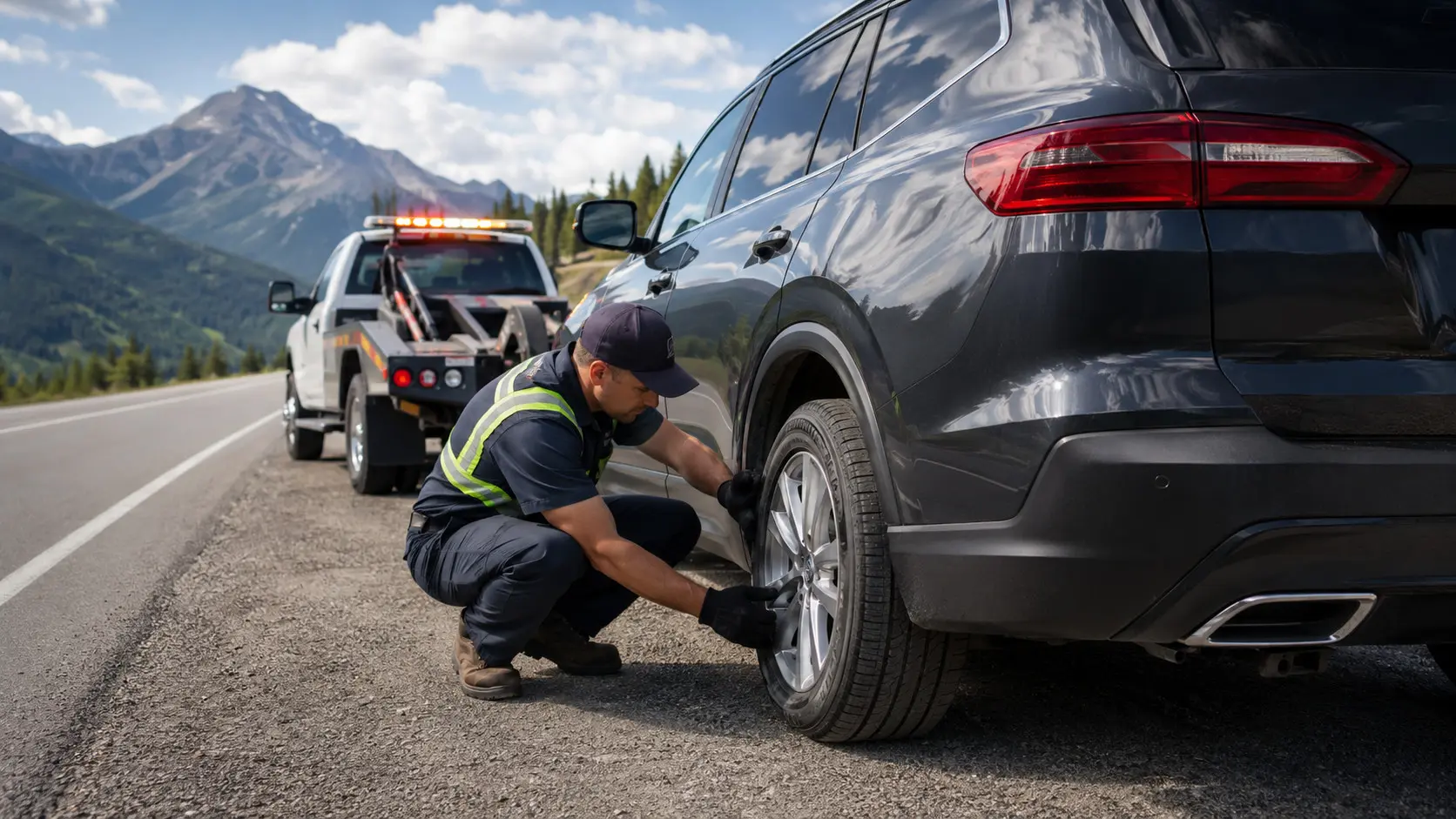
Summit currently states that its roadside assistance is available 24 hours a day, 365 days a year in both Canada and the United States for three years from the tire purchase date.
According to Summit’s published program, roadside assistance includes:
- Towing: up to US$100 toward towing to the nearest repair facility
- Flat-tire change: assistance changing the flat when the vehicle has a working spare
- Jump start: assistance when the vehicle will not start
- Fuel delivery: fuel can be delivered if you run out, although the cost of the fuel itself is excluded
For a value-oriented tire, these benefits add a useful layer of support. A dead battery in January, a flat on a highway trip or an empty fuel tank can turn into an expensive inconvenience, particularly when you are far from home.
But roadside assistance is not tire insurance. If you hit a pothole and destroy a tire, roadside assistance may help with an eligible service such as installing a usable spare or arranging covered towing, but that does not mean the damaged tire itself qualifies for free replacement under the manufacturer’s limited warranty.
What does “towing up to $100” mean?
Summit describes the towing benefit as up to $100 to the nearest repair facility. Drivers should not interpret that as unlimited-distance towing. A longer or more complicated tow can cost more than the program allowance, potentially leaving the driver responsible for the difference.
Before relying on any roadside program for a long Canadian trip, confirm the current terms and keep the assistance information accessible in the vehicle or on your phone.
Do you need a spare tire for flat-tire assistance?
Summit’s published roadside benefit specifies a flat-tire change with a working spare. That is particularly important with newer vehicles because some are sold without a conventional spare tire.
Before leaving on a road trip, check whether your vehicle carries a full-size spare, temporary spare, inflator kit or no spare at all. If it has a spare, verify its cold inflation pressure periodically. A spare that has been sitting unused for years may not be ready when you need it.
Does Summit’s U.S. Limited Tire Warranty Apply in Canada?
Canadian drivers should not assume it does. This is the most important detail to understand when researching Summit warranty coverage online.
Summit’s current published Passenger & Light Truck Limited Warranty states that warranty eligibility applies to qualifying Summit replacement tires operated in normal highway use in the USA. Its additional exclusions also identify tires on vehicles registered or operated outside the USA and tires not purchased in the USA through the Sailun Tire Americas distribution channel.
At the same time, Summit explicitly advertises its three-year roadside assistance as available in both Canada and the United States.
Those are two separate programs with different terms.
Important for Canadian buyers: Do not assume that seeing “Canada” in the roadside assistance description means every provision of Summit’s U.S. limited warranty automatically applies to a Canadian purchase. Ask the Canadian seller what manufacturer or distributor warranty applies to the exact Summit tire you are purchasing and request the applicable terms in writing.
This is good practice with any tire brand. Warranty policies can vary by country, distribution channel, tire model and purchase date.
What Does Summit’s Published Limited Warranty Cover?
For eligible U.S. purchases, Summit’s published limited warranty is designed to address tires that become unserviceable because of warrantable conditions rather than neglect, misuse or excluded damage.
The published policy applies to eligible Summit replacement passenger and light-truck tires with the required identification and specifies coverage during the usable tread life within the stated time limits.
For Canadian shoppers, these U.S. terms are useful for understanding how Summit structures its program, but they should not replace the warranty documentation provided for a Canadian sale.
Is every failed tire automatically covered?
No. Tire warranties distinguish between a warrantable condition and damage caused by use, maintenance, road hazards or vehicle problems.
For example, a tire may become unusable because of:
- A warrantable manufacturing condition
- Underinflation or overinflation
- A puncture
- Pothole impact
- Wheel misalignment
- Improper tire installation
- A damaged wheel or suspension component
- Improper repair
- Vehicle overloading
- Irregular treadwear
These causes are not treated the same way under a manufacturer’s warranty.
Road-Hazard Damage Is a Major Exclusion to Understand
Summit’s published limited warranty excludes road-hazard injuries, which means ordinary road damage should not be confused with a manufacturing defect.
The policy identifies damage from obstacles or debris, including cuts, punctures, snags, bruises, tears, abrasions and impact breaks among the excluded road-hazard conditions.
For Canadian drivers, this distinction is especially relevant. Potholes after repeated freeze-thaw cycles can be severe, while construction debris and damaged pavement can create tire hazards throughout the year.
If a tire is damaged after striking a pothole, the appropriate question is not simply, “Is my tire under warranty?” Instead, determine whether you purchased separate road-hazard protection from the retailer.
Roadside assistance versus road-hazard protection
| Situation | Roadside Assistance May Help With | Manufacturer Warranty Automatically Replaces Tire? |
|---|---|---|
| Flat tire with usable spare | Changing the tire | No |
| Pothole damages tire | Potential roadside service or towing within program terms | Not under the published limited warranty when it is road-hazard damage |
| Nail puncture | Flat-tire assistance where program conditions are met | Road-hazard punctures are excluded from the published limited warranty |
| Qualifying manufacturing condition | Roadside service may be separate | Potentially, subject to applicable warranty eligibility and inspection |
| Dead battery | Jump start | Not a tire warranty issue |
Which Summit Tires Receive Tread-Life Protection?
Select Summit passenger, SUV and light-truck tires carry published mileage protection, while other models do not. The mileage allowance also varies by model.
Summit’s current U.S. warranty table lists examples including:
| Summit Model | Published Tread-Life Protection |
|---|---|
| Ultramax A/S 2.0 | 60,000 miles / 60 months |
| Ultramax UHP AS | 50,000 miles / 60 months |
| Ultramax 4S | 60,000 miles / 60 months |
| Trail Climber SUV² | 60,000 miles / 60 months |
| Trail Climber HT03 — LT sizes | 50,000 miles / 60 months |
| Trail Climber HT03 — P-metric sizes | 60,000 miles / 60 months |
| Trail Climber AT02 | 50,000 miles / 60 months |
| Trail Climber RT | 50,000 miles / 60 months |
| Ultramax Winter Pro | No mileage protection listed |
| Trail Climber LMD | No mileage protection listed |
| Hi Road ST | No mileage protection listed |
These are Summit’s published U.S. mileage figures, so Canadian customers should verify the coverage applicable to tires purchased through their Canadian retailer rather than assuming the same mileage warranty applies.
A Treadwear Warranty Does Not Guarantee That Many Kilometres
A mileage warranty is a conditional warranty program, not a promise that every tire will travel the stated distance. Actual tread life depends on the vehicle, alignment, inflation pressure, driving habits, rotation, road surface, climate and other factors.
Summit’s U.S. policy describes eligible premature treadwear replacements as prorated. In practical terms, that means a tire that qualifies later in its life does not necessarily result in a completely free new tire.
The consumer may be responsible for part of the replacement tire’s cost based on tread already used. Mounting, balancing, taxes and other applicable service charges may also remain the customer’s responsibility.
Staggered fitments require extra attention
Summit’s published policy also states that vehicles with staggered fitments receive half mileage for rear tires when the rear tire size differs from the front.
That matters for some performance cars and SUVs because different front and rear sizes can prevent normal front-to-rear tire rotation.
Maintenance Records Can Matter as Much as the Warranty
Proper tire maintenance is essential because Summit’s published mileage protection requires appropriate inflation, balancing, rotation and alignment, along with supporting service records.
Summit states that mileage claims must include the original purchase invoice as well as invoices documenting required services performed on time.
That makes a simple maintenance file surprisingly valuable.
- Keep your original tire purchase invoice.
- Record the odometer reading when the tires are installed.
- Follow your vehicle manufacturer’s tire-rotation schedule.
- Keep invoices or records for rotations.
- Check cold inflation pressure regularly.
- Have unusual treadwear investigated early.
- Correct wheel-alignment or suspension problems when detected.
- Retain records for balancing or alignment work.
Summit’s U.S. policy says that if the vehicle manufacturer does not specify a rotation interval, tires should be rotated at least every 6,000 miles, or roughly 9,700 kilometres, or when uneven wear appears.
TireWarehouse Expert Tip: Do not wait for a warranty claim to start looking for maintenance records. Save tire invoices and rotation records from the day the tires are installed. They can also help you monitor tread life and identify unusual wear sooner.
What Can Void or Exclude a Summit Warranty Claim?
Many tire failures caused by maintenance, vehicle condition, impact damage or misuse are excluded from Summit’s published limited warranty.
Examples identified in Summit’s U.S. policy include:
- Improper or failed tire repairs
- Improper inflation or maintenance
- Incorrect tire size or specification
- Improper mounting or dismounting
- Tire and wheel imbalance
- Wheel misalignment
- Bent wheels or faulty vehicle components
- Accident or vandalism
- Certain chemical contamination
- Commercial applications such as taxis, shuttles and couriers
- Irregular treadwear
- Road-hazard damage
- Racing or certain off-road use
- Damage associated with snow chains or studs
- Improper storage that causes flat spotting
- Used tires
This is another reason proper tire inspection matters. If one shoulder of a tire is wearing dramatically faster than the rest of the tread, replacing the tire without correcting the underlying alignment or mechanical problem can simply repeat the damage.
Are Budget Tires a Good Choice for Canadian Driving?
Budget tires can make sense for Canadian drivers when the tire is appropriate for the vehicle, season, climate and expected use. The lowest purchase price, however, should never override correct fitment or winter traction requirements.
A driver using a commuter vehicle for moderate annual mileage may have different priorities from someone regularly travelling hundreds of kilometres on highways, towing a trailer or driving through severe winter conditions.
Budget tires may make sense when:
- You need a correctly sized replacement tire at a controlled cost.
- Your annual driving distance is moderate.
- You understand the tire’s intended season and performance category.
- The tire has the appropriate load and speed ratings for your vehicle.
- You are willing to maintain tire pressure, rotation and alignment.
- The tire’s traction characteristics suit the conditions where you drive.
Consider upgrading or comparing alternatives when:
- You regularly drive very high annual kilometres.
- Wet braking, winter traction or performance handling are major priorities.
- You drive extensively on remote highways.
- You tow or carry heavy loads that require specific tire capabilities.
- You want particular noise, comfort or rolling-resistance characteristics.
- You need a dedicated winter tire or a qualifying all-weather tire for specific winter conditions.
Do Not Confuse All-Season Tires With Canadian Winter Tires
Warranty coverage does not determine whether a tire is suitable for severe Canadian winter driving. You still need to choose the correct tire category for your climate and provincial requirements.
Conventional all-season tires are designed for a broad range of conditions, but their performance can decline as temperatures become colder. The commonly used 7°C guideline is a useful reminder to start thinking about seasonal tire changes as temperatures consistently approach that range.
For winter driving, look for the Three-Peak Mountain Snowflake (3PMSF) symbol where appropriate. Do not assume an M+S marking by itself provides the same indication of tested severe-snow performance.
This distinction also matters legally. Quebec has specific winter-tire requirements for many passenger vehicles during the mandated winter period, while designated routes in British Columbia have seasonal winter tire and chain requirements. Drivers should check current provincial requirements before travelling.
How to Decide Whether Summit Tires Offer Good Value
The best way to judge Summit—or any budget tire—is to compare total value rather than the sticker price alone.
Before purchasing, work through this checklist:
- Confirm fitment. Verify tire size, load index and speed rating against your vehicle requirements.
- Identify your season. Decide whether you need all-season, all-weather, dedicated winter or another tire type.
- Consider your climate. A driver in Vancouver may prioritize heavy-rain performance differently from someone regularly travelling through colder parts of Alberta, Manitoba or Northern Ontario.
- Check the exact model. Warranty and mileage protection can vary within the same brand.
- Ask about Canadian warranty coverage. Get the applicable terms from the Canadian seller rather than relying solely on Summit’s U.S. warranty page.
- Understand roadside assistance. Know the towing allowance and spare-tire requirement before you need service.
- Ask about road-hazard protection. Do not assume potholes and punctures are covered by the manufacturer’s defect warranty.
- Budget for installation. Mounting, balancing, valves, TPMS service and other charges can affect the installed cost.
- Plan maintenance. Tire pressure, rotation and wheel alignment can influence tread life and warranty eligibility.
- Keep your paperwork. Save your purchase and maintenance records.
The Bottom Line: What Are You Actually Getting With Summit?
Summit’s value proposition is more substantial than simply offering an inexpensive tire, but Canadian buyers need to separate the brand’s roadside assistance from its U.S. limited warranty terms.
Summit currently advertises three years of 24/7 roadside assistance throughout Canada and the United States, including a flat-tire change with a working spare, jump start, fuel delivery and towing up to $100 to the nearest repair facility.
Select Summit models also have published U.S. tread-life protection of 50,000 or 60,000 miles, while Summit’s limited warranty provides coverage for qualifying warrantable conditions under its eligibility rules.
However, road-hazard damage such as punctures, cuts and impacts is excluded from the published limited warranty, mileage adjustments can be prorated, maintenance documentation matters, and Summit’s current U.S. limited warranty specifically contains USA eligibility provisions and exclusions for vehicles registered or operated outside the USA.
For Canadian drivers, the smart approach is simple: compare the tire first, then verify the protection attached to the exact tire and Canadian purchase channel. A budget price can represent good value, but only when the tire suits your vehicle and conditions and you understand what the warranty and roadside programs actually provide.
Frequently Asked Questions About Summit Tires, Warranty and Roadside Assistance
Are Summit tires considered budget tires?
Summit generally competes as a value-focused tire brand. That does not automatically determine whether a tire is suitable for your vehicle. Compare the exact model’s specifications, seasonal capability, traction characteristics, warranty and expected use rather than judging it solely by price.
Does Summit offer roadside assistance in Canada?
Yes. Summit currently states that its roadside assistance is available in Canada and the United States 24 hours a day, 365 days a year for three years from the purchase date.
What does Summit roadside assistance include?
Summit lists towing up to $100 to the nearest repair facility, flat-tire changing with a working spare, jump-start service and fuel delivery. The cost of the delivered fuel is excluded.
Does Summit roadside assistance replace a damaged tire?
Not necessarily. Roadside assistance is a service program, not automatic tire replacement coverage. It may help you after a breakdown, but whether the tire itself qualifies for replacement depends on the applicable warranty or separate road-hazard coverage.
Does Summit’s manufacturer warranty cover pothole damage?
Summit’s published U.S. limited warranty excludes road-hazard injuries, including various punctures, cuts and impact damage. Canadian customers should also review any separate road-hazard protection offered by their retailer.
Does Summit’s U.S. tire warranty apply in Canada?
Canadian buyers should not assume that it does. Summit’s currently published limited warranty specifies USA eligibility and includes exclusions concerning vehicles registered or operated outside the USA. Confirm the warranty applicable to your Canadian purchase directly with the seller.
How long is Summit roadside assistance available?
Summit states that the program is available for three years from the purchase date of the Summit tires.
Do all Summit tires have a mileage warranty?
No. Summit’s published U.S. warranty table provides tread-life protection for select models, while models such as the Ultramax Winter Pro, Trail Climber LMD and Hi Road ST are listed without mileage protection.
Do I need to rotate Summit tires to maintain treadwear warranty eligibility?
Under Summit’s published U.S. mileage policy, proper rotation and other maintenance are required. Summit says tires should be rotated according to the vehicle or tire manufacturer’s recommendations and specifies a minimum interval of 6,000 miles, approximately 9,700 kilometres, when the vehicle manufacturer provides no interval.
Should I keep my tire rotation receipts?
Yes. Keeping the original purchase invoice and maintenance documentation is good practice for any tire. Summit’s U.S. tread-life policy specifically requires documentation for applicable mileage claims.
Are Summit all-season tires suitable for Canadian winters?
That depends on the exact tire model, markings, temperatures, road conditions and provincial requirements. Do not assume that any all-season tire provides the same winter capability as a 3PMSF-rated winter or all-weather tire.
Is a budget tire worth buying if it includes roadside assistance?
Roadside assistance can add useful value, but it should not be the main reason to select a tire. Correct fitment, braking, traction, seasonal suitability, load capacity, expected tread life and total installed price should remain central to the decision.
Recommended Related Reading
- Cheap Tires vs. Premium Tires: What’s the Real Difference?
- How to Choose the Right Tires for Your Vehicle in Canada
- All-Weather vs. All-Season Tires: What Canadian Drivers Need to Know
- Tire Warranties Explained: Treadwear, Road Hazard and Manufacturer Coverage
- How Often Should You Rotate Your Tires?
In stock & ready to ship
Find the tires you need, delivered from a warehouse near you