
Gravel, Dust, and Washboard Roads
How the Summit Trail Climber AT02 handles loose gravel, dusty access routes, corrugated surfaces, and the highway kilometres between Canadian adventures.
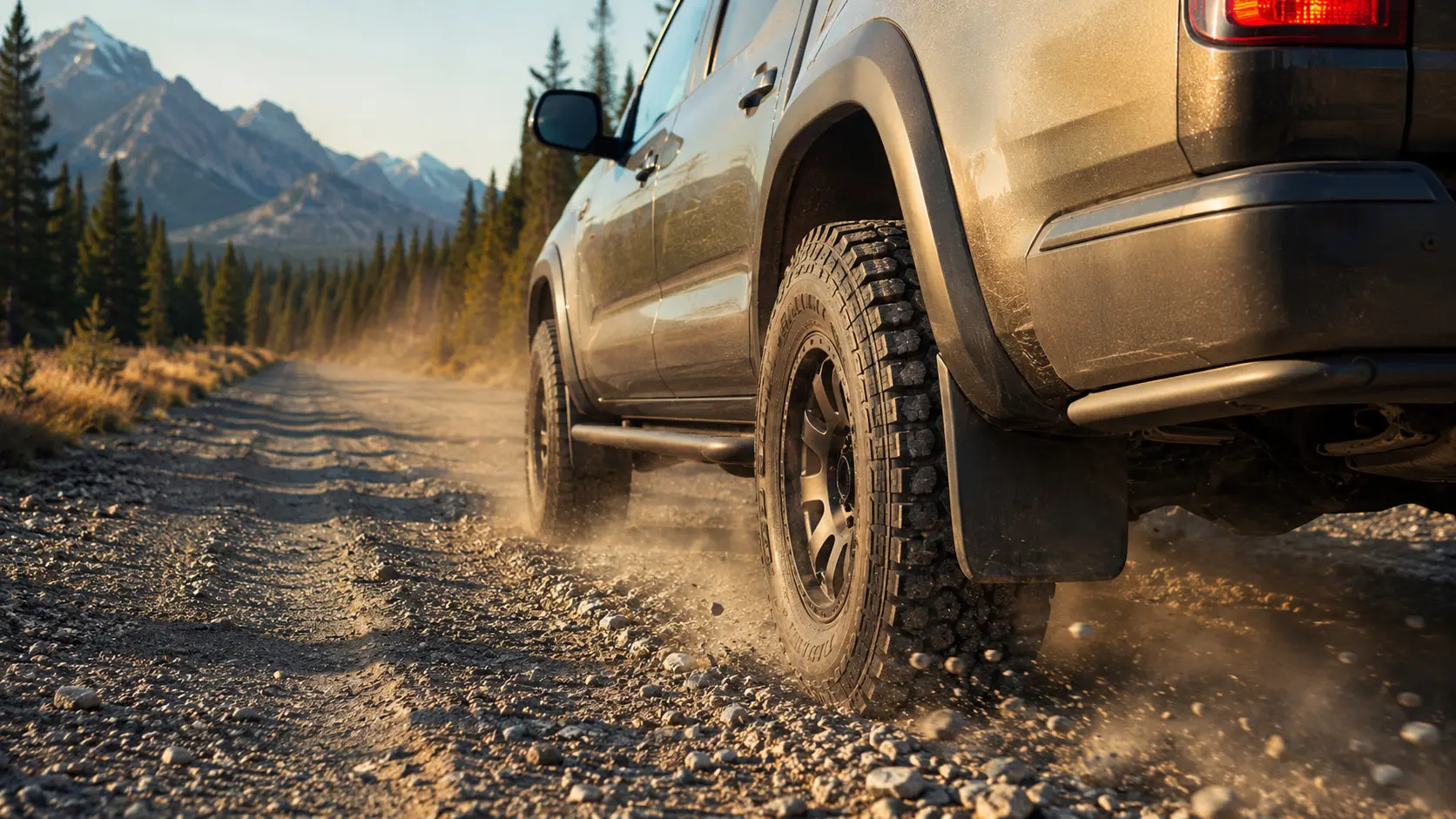
Gravel, Dust, and Washboard Roads: Why the Trail Climber AT02 Thrives Off the Pavement
Unpaved roads ask more of a tire than most drivers realize. Loose gravel reduces steering precision, dust can hide potholes and sharp stones, and washboard corrugations repeatedly disturb the tire’s contact with the road. A conventional highway tire may manage an occasional cottage road, but drivers who regularly travel beyond the pavement need stronger traction, appropriate tread depth, and stable shoulder support.
The Summit Trail Climber AT02 is an all-terrain tire designed for trucks and SUVs that divide their time between everyday roads and recreational trails. Its wide tread footprint, reinforced shoulders, deep tread, scalloped shoulder blocks, sidewall biters, and water-evacuating grooves make it particularly well suited to gravel roads and other variable surfaces. It is not a dedicated rock-crawling or extreme-mud tire, but it offers a practical balance for Canadian drivers who need off-pavement capability without giving up everyday road manners.
Why Gravel, Dust, and Washboard Roads Are Hard on Tires
Unpaved roads create an unstable contact surface, so traction, steering response, ride control, and tire durability can change from one section of road to the next.
On pavement, a tire rolls across a relatively consistent surface. On gravel, the tread may be gripping stones that are themselves moving. The tire must displace loose material, find firmer ground underneath, and maintain as much contact as possible while the vehicle accelerates, brakes, and changes direction.
Loose Gravel Reduces Predictability
Gravel can behave like a layer of marbles over a harder base. During cornering or braking, the stones can roll or slide before the tire establishes a secure contact patch. This can make steering feel lighter, increase stopping distance, and allow the vehicle to drift toward the outside of a bend.
An all-terrain tread helps by providing more defined biting edges and greater space between tread elements than a typical highway-oriented pattern. That does not create pavement-like grip, but it can help the tire engage loose material and reach the firmer surface below.
Dust Hides Hazards
Fine dust reduces visibility and can conceal potholes, embedded rocks, ruts, standing water, and changing road texture. Dust may also settle inside tread channels, especially when mixed with clay or moisture. A tire needs sufficient groove volume and tread depth to continue working as the surface changes from dry powder to damp, compacted soil.
Drivers should also remember that the tire cannot compensate for limited visibility. Increasing following distance, slowing before entering a dust cloud, and avoiding sudden steering inputs remain essential.
Washboard Roads Disturb the Contact Patch
Washboard roads are covered with closely spaced ripples or corrugations. As the tire moves over them, the wheel repeatedly rises and falls. At an unsuitable speed, the tire can spend less time firmly loaded against the road, reducing steering authority and braking stability.
Tire construction, tread stability, sidewall characteristics, vehicle suspension, load, speed, and inflation pressure all affect how the vehicle reacts. No tire removes washboard vibration, but the right all-terrain design can provide a more controlled foundation than a lightly built pavement tire.
Sharp Stones Increase Damage Risk
Freshly graded roads, forestry routes, mining access roads, and remote construction routes can contain angular stone. These surfaces may cut tread blocks, bruise the casing, or damage a sidewall, particularly when a driver hits an exposed rock at speed.
Reinforced construction can improve resilience, but no all-terrain tire is puncture-proof. Careful wheel placement and appropriate speed still matter.
What Makes the Trail Climber AT02 Suited to Unpaved Roads?
The AT02 addresses mixed-surface driving with a wide footprint, reinforced shoulders, deep tread, aggressive shoulder features, and multiple channels for water evacuation.
Summit positions the Trail Climber AT02 as an all-terrain tire for trucks and SUVs that can be used on trails as well as daily roads and highways. Its design is less extreme than a mud-terrain tire, which is an advantage for drivers who still complete most of their kilometres on pavement. :contentReference[oaicite:1]{index=1}
| AT02 Design Feature | Purpose on Unpaved Roads | Practical Driver Benefit |
|---|---|---|
| Wide tread footprint | Distributes contact pressure across a broad area | Supports stability and more even tread wear |
| Reinforced shoulders | Supports the outer tread during cornering and impacts | More controlled response on ruts, gravel edges, and uneven surfaces |
| Scalloped shoulder blocks | Adds biting edges near the sides of the tread | Helps the tire engage loose gravel and soft road shoulders |
| Enhanced sidewall biters | Provides additional traction features beyond the central tread | Useful when passing through ruts or loose trail sections |
| Deep tread | Provides groove volume and substantial tread elements | Supports traction in gravel, dirt, light mud, and snow |
| Four circumferential grooves | Moves water through the tread | Helps manage wet pavement, rain-soaked gravel, and standing water |
| Lateral shoulder channels | Provides additional evacuation paths toward the tread edges | Helps clear water and loose material from the contact area |
Summit states that the wide footprint and reinforced shoulders are intended to distribute pressure evenly and promote consistent wear. The manufacturer also identifies scalloped shoulders, deep tread, sidewall biters, four circumferential grooves, and lateral shoulder channels as core AT02 features. :contentReference[oaicite:2]{index=2}
How the AT02 Performs on Loose Gravel
On gravel, the AT02’s tread edges and shoulder design help it find traction while its broad footprint supports a more stable feel.
The tread pattern includes substantial centre blocks and more open areas toward the shoulders. As the tire rolls, these edges can press into loose stone rather than relying on a continuous rib designed primarily for pavement. The result should be more useful mechanical engagement when accelerating from a stop, climbing a loose grade, or maintaining momentum through deeper gravel.
Steering on Gravel Corners
Reinforced shoulders matter because cornering loads move toward the outer portion of the tire. On an unpaved bend, the surface may already be shifting under the tread. Better-supported shoulder elements can reduce excessive tread movement and help the driver make smoother, more predictable steering corrections.
That does not mean the AT02 can prevent understeer or sliding. Gravel-road speed should be set according to sightlines, road width, surface depth, traffic, and the possibility of wildlife or oncoming vehicles.
Braking on Loose Surfaces
Braking distance will usually be longer on loose gravel than on dry pavement because the road material can move beneath the tread. The AT02’s biting edges can help, but the greatest safety benefit still comes from reducing speed before a curve, hillcrest, intersection, or cattle guard rather than attempting a late stop.
Expert tip: Treat every transition between packed gravel and freshly graded stone as a change in available traction. Reduce speed before the loose section and make steering, throttle, and brake inputs progressively.
Why the AT02 Works Well on Dusty Roads
The AT02’s deep, channelled tread gives dust and loose material more space to move than a closely packed highway tread.
Dry gravel roads can produce fine powder that settles around the tread blocks. The AT02’s open shoulder areas, circumferential grooves, and lateral channels provide pathways through which some loose material can move as the tire rotates. This is a design-based advantage, although actual clearing performance will vary with dust type, moisture, wheel speed, tread wear, and vehicle load.
Dry Dust Versus Wet Clay
Dry mineral dust is relatively easy for a rotating tread to displace. Once that dust mixes with rain, however, it may become a slick paste or sticky clay. Deep tread and open channels can help, but the AT02 is still a balanced all-terrain tire rather than a highly open mud-terrain pattern.
Drivers who routinely travel through deep, adhesive mud may need a more aggressive tire. For maintained gravel roads, cottage routes, jobsite access, and occasional muddy sections, the AT02 offers a more road-friendly compromise.
Visibility Still Determines Safe Speed
When another vehicle creates a dense dust cloud, traction is only one part of the risk. The driver may not be able to see a stopped vehicle, washout, animal, or sharp bend. Increase following distance and wait for the dust to clear instead of remaining close to the vehicle ahead.
How the Trail Climber AT02 Handles Washboard Roads
On washboard surfaces, the AT02 provides sturdy tread and shoulder support, but speed and inflation pressure remain critical to keeping the tires in contact with the road.
Corrugations can make a vehicle feel as though it is floating, skipping sideways, or losing steering precision. The sensation becomes more pronounced when the suspension cannot settle before the next ripple.
The AT02’s manufacturer-rated emphasis on ride comfort, broad footprint, and supported shoulders makes it a sensible choice for mixed road use. However, drivers should not interpret an all-terrain label as permission to carry highway speed onto a corrugated road.
Do Not Chase a “Magic” Washboard Speed
Some drivers accelerate in an attempt to skim over corrugations. Although the vibration may feel different at a higher speed, the tires may also have less consistent contact with the surface. That can reduce the margin available for braking, steering around a pothole, or reacting to an oncoming vehicle.
The safer approach is to reduce speed progressively until the steering feels settled and the vehicle responds predictably. Avoid abrupt braking while the wheels are bouncing. Slow before the rough section whenever possible.
Use the Correct Inflation Pressure
Transport Canada recommends checking pressure when tires are cold and using the vehicle manufacturer’s recommended pressures, normally found on the driver’s door placard or in the owner’s manual. A tire is considered cold after the vehicle has been parked for at least three hours or driven less than approximately 2 km. The maximum pressure printed on the tire sidewall is not automatically the correct operating pressure for the vehicle.
Some experienced off-road drivers reduce pressure for particular low-speed terrain, but that should only be done within guidance appropriate to the vehicle, tire, load, wheel, and route. Excessive pressure reduction can create heat, reduce load capacity, allow sidewall damage, or unseat a tire from the wheel. The tire must also be reinflated before returning to normal road speeds.
AT02 Versus Highway-Terrain and Mud-Terrain Tires
The AT02 occupies the practical middle ground between a pavement-focused highway tire and an aggressive mud-terrain tire.
| Characteristic | Highway-Terrain Tire | Trail Climber AT02 | Mud-Terrain Tire |
|---|---|---|---|
| Paved-road comfort | Typically highest | Balanced for daily use | Usually firmer and noisier |
| Loose gravel traction | Suitable for occasional maintained roads | Well suited to regular gravel use | Strong traction but more capability than many drivers need |
| Light mud | Limited | Moderate capability | Strong capability |
| Deep mud | Poor | Not its primary purpose | Best of the three |
| Washboard-road use | Depends heavily on casing and vehicle setup | Good mixed-surface balance | Durable, but tread and casing may feel heavier |
| Road noise | Usually lowest | Moderate all-terrain pattern | Usually highest |
| Fuel efficiency | Often most favourable | May have more rolling resistance | Often least favourable |
| Ideal driver | Mostly pavement | Highway plus regular backroad use | Frequent severe off-road terrain |
A driver who only encounters a short, well-maintained driveway may be better served by a highway-terrain tire. A driver who spends weekends in deep mud or on severe technical trails may need a mud-terrain design. The AT02 makes the strongest case for drivers whose routes include substantial pavement plus repeated gravel, dirt, cottage, farm, worksite, or recreational access roads.
What the AT02’s Tread Depth Means
The AT02 uses deeper tread in its LT and flotation sizes than in its passenger-oriented sizes, reflecting the different demands of light-truck applications.
According to Summit’s product sheet, listed passenger and SUV sizes generally begin with 13/32-inch tread depth. Listed LT and flotation sizes generally use 16/32-inch tread depth. The lineup includes standard-load, extra-load, 6-ply-rated, and 10-ply-rated applications, depending on size.
| AT02 Configuration | Typical Listed Tread Depth | Potential Application |
|---|---|---|
| Passenger-metric or SUV size | 13/32 inch | Daily-driven SUVs, crossovers, and lighter-duty trucks |
| LT 10PR size | 16/32 inch | Light trucks carrying heavier loads or operating in more demanding conditions |
| Flotation size | 16/32 inch | Compatible trucks using approved larger-diameter off-road-oriented sizing |
Deeper tread can provide greater groove volume and longer usable tread life, but it does not automatically make an LT tire the best choice for every truck. LT tires can be heavier and may produce a firmer ride. The correct load index, speed rating, wheel size, and inflation requirements must match the vehicle.
Choosing Between Standard, XL, and LT AT02 Sizes
The best AT02 size is the one that satisfies the vehicle manufacturer’s fitment and load requirements—not simply the version with the highest ply rating.
Standard-Load and XL Sizes
Standard-load and extra-load sizes may suit SUVs and trucks used for commuting, family travel, light towing, and recreational gravel roads. These versions can provide the AT02 tread design without the additional weight and stiffness associated with some LT constructions.
LT and 10PR Sizes
LT sizes are intended for light-truck applications and may be appropriate for heavier payloads, towing, work equipment, or sustained use on demanding roads. Many AT02 LT sizes in Summit’s current product sheet carry a 10PR designation, but load index and operating pressure differ by size.
Never select a tire based on “10-ply” terminology alone. Confirm the load index, load range, wheel compatibility, vehicle placard, and actual operating weight. TireWarehouse’s guide to understanding tire load ratings explains how these markings affect carrying capacity.
Is the Trail Climber AT02 Suitable for Canadian Winter Conditions?
The AT02 carries the Three-Peak Mountain Snowflake symbol, but drivers should still match their winter tire choice to local conditions and regulations.
Summit identifies the AT02 as 3PMSF-certified. The symbol indicates that the tire has met a standardized severe-snow traction performance threshold. This gives the AT02 an advantage over an all-terrain tire carrying only an M+S marking when roads are covered with packed or loose snow.
However, 3PMSF certification does not mean every certified all-terrain tire performs like a dedicated winter tire on glare ice, black ice, or extremely cold pavement. Drivers in areas with prolonged freezing temperatures, frequent ice, steep winter routes, or severe storms may still benefit from a dedicated winter tire.
Provincial rules and posted route requirements can change, so drivers should verify current requirements before winter travel. Learn more in TireWarehouse’s guide to the 3PMSF symbol and Canadian winter driving.
Where the AT02 Makes Sense in Canada
The AT02 is a logical fit for Canadian drivers who regularly transition between paved highways and maintained or moderately challenging unpaved roads.
- Cottage-country access: Gravel concession roads and private lanes in Ontario, Quebec, Manitoba, and Atlantic Canada.
- Forestry and resource roads: Mixed gravel, rock, dust, ruts, and seasonal moisture in British Columbia, Alberta, and Northern Ontario.
- Prairie grid roads: Long stretches of hard-packed gravel that can become dusty in summer and slippery after rain.
- Farm and ranch use: Field access, gravel approaches, equipment yards, and rural roads.
- Camping and recreation: Routes to trailheads, boat launches, campsites, fishing areas, and remote cabins.
- Construction and worksite access: Repeated travel over compacted stone, dirt, and partially developed roads.
Conditions can change quickly in all of these environments. A dry gravel road in the morning may develop standing water, soft shoulders, or exposed stone after a storm. The AT02’s combination of all-terrain tread and water channels gives drivers a more versatile setup for these transitions than a purely pavement-focused tire.
How to Prepare the AT02 for a Gravel-Road Trip
A pre-trip tire inspection is as important as the tread pattern, especially before travelling into an area with limited cellular service or roadside assistance.
- Confirm cold inflation pressure. Use the vehicle placard or owner’s manual rather than the maximum pressure printed on the tire.
- Inspect the tread. Look for embedded nails, sharp stones, cuts, missing tread pieces, or unusual wear.
- Check the sidewalls. Do not ignore bulges, exposed cords, deep scrapes, or cracking.
- Verify tread depth. Measure several points across every tire rather than relying on one groove.
- Inspect the spare. Confirm its pressure and make sure the jack, wheel wrench, and locking-wheel key are accessible.
- Check the load. Do not exceed the vehicle, axle, wheel, or tire load limits.
- Secure cargo. Shifting gear can affect vehicle balance on loose corners and corrugated surfaces.
- Plan for communication. Remote routes may require a satellite communicator, paper map, or shared travel plan.
Transport Canada recommends measuring tire pressure at least monthly and before long trips, while also inspecting for cuts, cracks, bulges, foreign objects, and uneven wear.
Maintenance After Driving on Gravel and Washboard
After a rough-road journey, inspect the AT02 for damage and wear before small issues become expensive problems.
Remove Trapped Stones Carefully
Small stones can lodge in the tread grooves. Many will release during normal driving, but larger or sharp pieces should be removed carefully once the tire is cool and the vehicle is safely parked. Do not use a tool that could puncture or cut the rubber.
Look for Sidewall Damage
Check both the outer and accessible inner sidewalls for cuts, abrasions, bulges, or impact marks. A bulge may indicate internal structural damage and should be evaluated promptly by a tire professional.
Watch for Alignment Symptoms
Potholes, embedded rocks, and severe washboard can disturb alignment or damage steering and suspension components. Have the vehicle inspected when it begins pulling to one side, the steering wheel no longer sits centred, or the tread develops rapid uneven wear.
Maintain a Rotation Schedule
All-terrain tires may develop irregular wear when used under high torque, heavy loads, or repeated gravel conditions. Follow the vehicle and tire manufacturer’s rotation guidance. Frequent inspection is especially important on four-wheel-drive vehicles, where large tread-depth differences can affect drivetrain operation.
Common Mistakes to Avoid with All-Terrain Tires
The AT02 provides useful capability, but incorrect pressure, excessive speed, poor fitment, and overconfidence can eliminate much of its advantage.
- Using the sidewall maximum as the normal pressure: The sidewall value is not automatically the vehicle’s recommended operating pressure.
- Reducing pressure without a reinflation plan: Driving an aired-down tire at road speed can generate heat and damage.
- Choosing an LT tire only for appearance: A heavier casing may reduce ride comfort when the vehicle does not need the additional capacity.
- Carrying pavement speed onto gravel: Loose stone increases stopping distance and reduces cornering grip.
- Braking hard on washboard: A bouncing tire may not maintain consistent contact with the road.
- Assuming an A/T tire cannot be punctured: Sharp rocks can damage any tread or sidewall.
- Treating 3PMSF as an ice guarantee: Severe-snow certification does not eliminate the limitations of ice traction.
- Ignoring the spare tire: A usable spare is particularly important on remote Canadian routes.
Who Should Consider the Trail Climber AT02?
The AT02 is best for truck and SUV drivers who need meaningful gravel-road capability while retaining reasonable comfort for daily pavement use.
The AT02 Is a Strong Candidate When You:
- Drive regularly on gravel, dirt, farm, cottage, forestry, or worksite roads.
- Need one tire for weekday commuting and weekend outdoor travel.
- Want deeper tread and more aggressive shoulders than a highway-terrain tire.
- Prefer a less extreme and potentially more road-friendly option than a mud-terrain tire.
- Need a 3PMSF-certified all-terrain option for seasonal snow traction.
- Require an available LT or higher-load configuration for an appropriate truck application.
Another Tire Type May Be Better When You:
- Drive almost exclusively on pavement and prioritize minimum road noise and rolling resistance.
- Frequently encounter deep mud, large rocks, or severe technical trails.
- Need the strongest possible ice performance from a dedicated winter tire.
- Want to change tire diameter or load type without verifying wheel, suspension, gearing, clearance, and vehicle compatibility.
Trail Climber AT02 Warranty and Size Coverage
The AT02 is offered in a broad range of truck and SUV sizes and carries a manufacturer-listed 50,000-mile limited treadwear warranty.
Fifty thousand miles is approximately 80,000 km. Actual eligibility, exclusions, maintenance requirements, and Canadian warranty administration should be confirmed before purchase. Warranty coverage does not guarantee that every driver will achieve the stated distance because tread life varies with pressure, alignment, rotation, vehicle weight, towing, road surface, and driving behaviour.
The official product information lists passenger-metric, LT, and flotation sizes for wheel diameters from 15 to 22 inches. Because availability can vary, search by vehicle or approved tire size and verify the load index and speed rating before ordering.
Final Recommendation: Is the AT02 a Good Backroad Tire?
Yes—the Trail Climber AT02 is a compelling value-oriented option for Canadian drivers who regularly travel on gravel, dusty access roads, and moderate washboard while still needing everyday highway usability.
Its greatest strength is balance. The wide footprint and reinforced shoulders support stability and even wear. Scalloped shoulders, sidewall biters, and deep tread provide useful engagement on loose surfaces. Four circumferential grooves and lateral channels help the tire adapt when a dry gravel road becomes wet. The 3PMSF marking also adds verified severe-snow traction capability, although dedicated winter tires may remain preferable for demanding ice and cold-weather conditions. :contentReference[oaicite:12]{index=12}
The AT02 cannot eliminate washboard vibration, shorten every gravel-road stop, or prevent damage from sharp rock. Its performance still depends on correct fitment, cold inflation pressure, tread condition, vehicle load, suspension health, road conditions, and driver decisions.
For a truck or SUV that spends most of its time on pavement but regularly heads toward campsites, cottages, farms, worksites, trailheads, or remote Canadian destinations, the Trail Climber AT02 offers the type of versatility an all-terrain tire should deliver. Check current fitment and availability among TireWarehouse’s light-truck tire options.
Frequently Asked Questions About the Trail Climber AT02
Is the Trail Climber AT02 good on gravel roads?
Yes. Its deep all-terrain tread, wide footprint, reinforced shoulders, scalloped shoulder blocks, and sidewall traction features make it well suited to maintained gravel, loose stone, and mixed dirt roads. Drivers must still reduce speed because gravel provides less predictable braking and cornering traction than pavement. :contentReference[oaicite:13]{index=13}
Does the AT02 ride smoothly on washboard roads?
It can provide an appropriate all-terrain foundation, but no tire makes washboard roads smooth. Ride quality depends on the tire size and construction, inflation pressure, suspension, vehicle load, corrugation spacing, and speed. Slow down until the vehicle feels settled and responsive.
Is the Trail Climber AT02 a noisy tire?
Summit describes the AT02 as designed for a smooth and quiet ride and gives it a manufacturer-published quietness score of 8 out of 10. Actual cabin noise will vary with tire size, vehicle insulation, road texture, wear, rotation practices, and inflation pressure. :contentReference[oaicite:14]{index=14}
Can I use the AT02 for daily highway driving?
Yes. It is designed as a mixed-use all-terrain tire for daily roads, highways, and trails. It may produce more tread noise and rolling resistance than a highway-terrain tire, but it should be more practical for everyday pavement than a highly aggressive mud-terrain design. :contentReference[oaicite:15]{index=15}
Is the Trail Climber AT02 a winter tire?
It is a 3PMSF-certified all-terrain tire, meaning it meets a standardized severe-snow traction threshold. It should not automatically be considered equivalent to a dedicated winter tire for glare ice, extreme cold, or severe winter routes. :contentReference[oaicite:16]{index=16}
How deep is the Trail Climber AT02 tread?
The manufacturer’s current product sheet lists 13/32-inch tread depth for many passenger-oriented sizes and 16/32-inch depth for listed LT and flotation sizes. Confirm the specification for the exact size being purchased. :contentReference[oaicite:17]{index=17}
Should I buy the LT version of the AT02?
Choose an LT version when it is appropriate for the vehicle’s load, towing requirements, intended use, and approved fitment. Do not select an LT or 10PR tire solely because it appears stronger. Heavier constructions can affect ride comfort, pressure requirements, weight, and fuel consumption.
What pressure should I run on gravel roads?
For normal use, begin with the vehicle manufacturer’s recommended cold pressure on the door placard or in the owner’s manual. Do not use the tire sidewall’s maximum pressure as a universal target. Any off-road pressure adjustment should account for vehicle weight, tire construction, load, speed, terrain, and the need to reinflate before highway travel. :contentReference[oaicite:18]{index=18}
Can the AT02 be used for towing?
Potentially, provided the selected size has the correct load index, load range, pressure capability, and fitment for the tow vehicle. The vehicle, axle, wheel, hitch, and tire limits must all be respected. Towing suitability should be determined from the exact tire specification rather than the AT02 model name alone.
Is the AT02 suitable for deep mud?
It can handle light mud and changing gravel-road conditions, but deep or sticky mud is not its main purpose. Drivers who regularly travel through severe mud may benefit from a more open mud-terrain tread pattern.
How often should I rotate Trail Climber AT02 tires?
Follow the vehicle owner’s manual and applicable warranty requirements. Inspect the tread frequently and consider earlier service when repeated gravel travel, towing, four-wheel drive, or high torque causes uneven wear.
Does the AT02 resist sharp gravel punctures?
Its reinforced shoulders and LT construction options may provide useful durability, but the tire is not puncture-proof. Reduce speed on angular stone, avoid striking exposed rocks, and inspect the tread and sidewalls after demanding routes.
What is the Trail Climber AT02 treadwear warranty?
Summit lists a 50,000-mile limited treadwear warranty, equivalent to approximately 80,000 km. Coverage conditions, exclusions, proof-of-maintenance requirements, and availability should be confirmed for the exact tire and Canadian purchase. :contentReference[oaicite:19]{index=19}
Recommended Related Reading
In stock & ready to ship
Find the tires you need, delivered from a warehouse near you