
All-Terrain Grip That’s Ready When Temperatures Drop
The Summit Trail Climber RT combines an aggressive on/off-road tread with 3PMSF severe-snow certification, giving pickup and SUV drivers added versatility when gravel, mud, snow, and falling temperatures can all be part of the same trip.
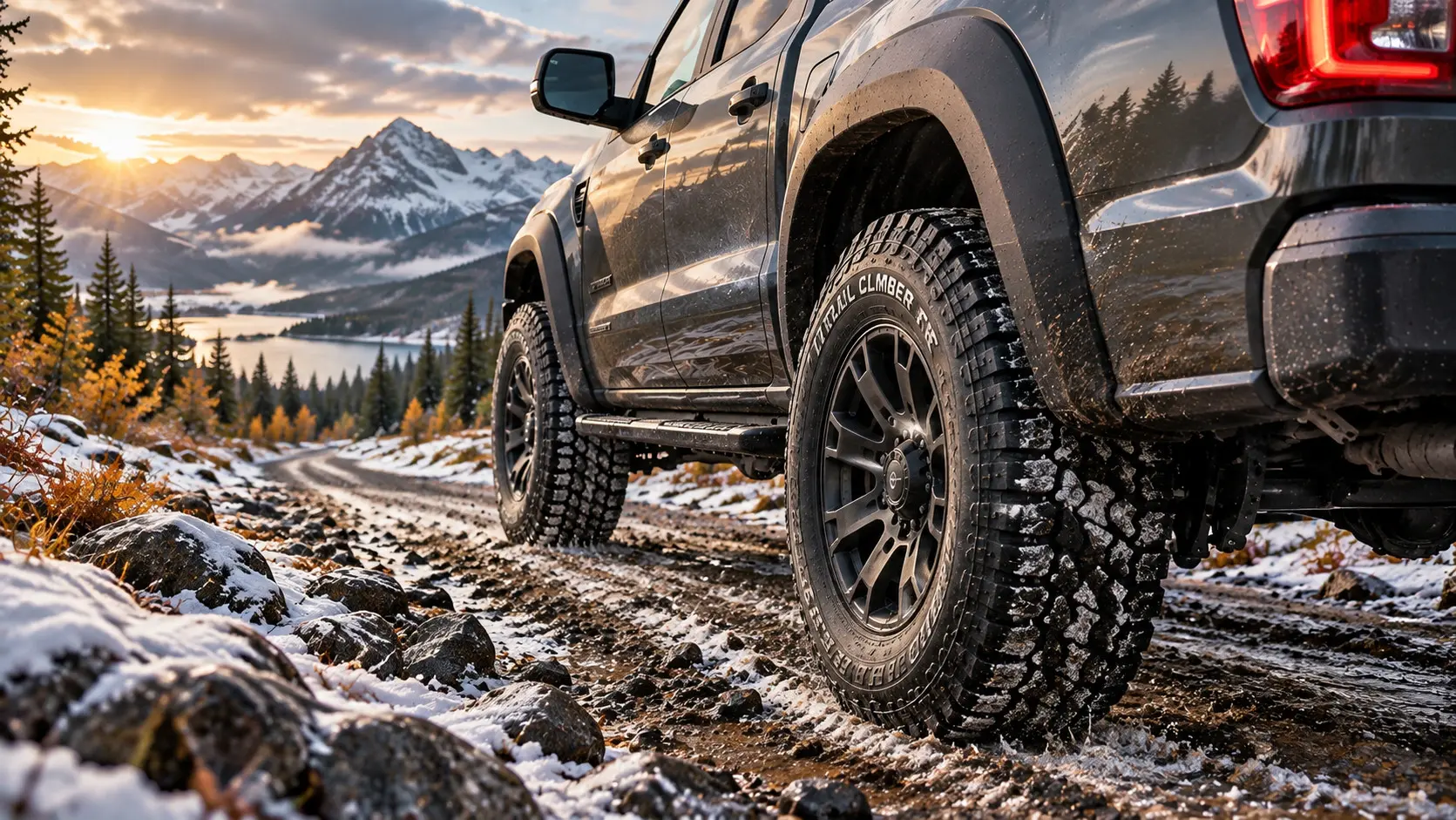
Trail Climber RT and 3PMSF: All-Terrain Grip That’s Ready When Temperatures Drop
For Canadian pickup and SUV drivers, an all-terrain tire often has to do more than handle gravel roads and weekend trails. It may also face cold autumn mornings, wet highways, early-season snow, slush, unpaved work sites, and rapidly changing conditions on the same trip.
The Summit Trail Climber RT is designed for that kind of mixed use. Its rugged-terrain tread combines deep stepped lugs, scalloped shoulders, aggressive sidewall biters, and an on/off-road rubber compound. Just as importantly for Canadian drivers, the Trail Climber RT carries the Three-Peak Mountain Snowflake (3PMSF) symbol, indicating that it meets specified performance requirements for traction in severe snow conditions.
That combination makes the Trail Climber RT particularly interesting for drivers who want rugged-terrain capability without ignoring cold-weather traction. But the 3PMSF symbol has a specific meaning, and it should not be interpreted as a guarantee of equal performance in every winter condition.
What Is the Summit Trail Climber RT?
The Summit Trail Climber RT is a rugged-terrain tire for light trucks and SUVs designed to balance off-road traction with everyday road use. It sits in the space between conventional highway-focused tires and more specialized off-road designs, making it relevant to drivers whose vehicles regularly move between pavement and rougher surfaces.
According to Summit, key Trail Climber RT features include:
- Deep stepped tread lugs
- Scalloped shoulder areas
- Aggressive sidewall biters
- A proprietary rubber compound engineered for on- and off-road use
- Three-Peak Mountain Snowflake certification
The combination is intended to provide traction and stability across multiple terrains while giving the tire a distinctly rugged tread design. Depending on size, available specifications can differ, so load index, speed rating, load range, inflation requirements, and vehicle fitment should always be checked before purchase.
Expert tip: Never choose a rugged-terrain tire based on appearance alone. The correct tire must meet your vehicle manufacturer’s size, load capacity, speed rating, and other fitment requirements.
What Does 3PMSF Mean on the Trail Climber RT?
3PMSF means the Trail Climber RT has met a defined snow-traction performance requirement for severe snow conditions. The symbol shows a snowflake inside a three-peaked mountain and is sometimes called the Alpine symbol.
Transport Canada advises consumers to look for the mountain-and-snowflake symbol when shopping for winter tires and states that tires carrying it meet specific snow-traction performance requirements. Transport Canada documentation explains that qualifying passenger and light-truck tires undergo traction testing on medium-packed snow against a reference tire.
That distinction matters because a 3PMSF marking is more meaningful for severe-snow traction than simply seeing an aggressive-looking tread.
3PMSF Is a Performance Standard, Not a Tread-Style Label
A tire does not earn the Three-Peak Mountain Snowflake designation simply because it has large tread blocks or is marketed for trucks. The designation is linked to standardized snow-traction performance criteria.
For Trail Climber RT shoppers, this means the 3PMSF marking provides useful information beyond its rugged tread appearance: the tire has demonstrated the required level of traction in the applicable severe-snow test.
Is 3PMSF the Same as M+S?
No. The 3PMSF symbol and M+S marking are not equivalent indicators of snow performance. M+S stands for Mud and Snow, while 3PMSF is associated with a specific severe-snow traction performance requirement.
| Marking | What It Indicates | What Canadian Drivers Should Know |
|---|---|---|
| M+S | Mud and Snow designation | Common on many all-season and truck tires; it should not be treated as equivalent to the 3PMSF severe-snow performance designation. |
| 3PMSF | Meets specified severe-snow traction performance requirements | Provides a performance-based indication of snow capability and is particularly relevant for cold-weather Canadian driving. |
This difference becomes especially useful when comparing rugged-terrain tires. Two tires may both look capable on gravel and carry M+S markings, but a 3PMSF designation gives the buyer an additional standardized indicator of snow traction capability.
Why Does 3PMSF Matter When Temperatures Drop?
Canadian shoulder seasons can expose a truck or SUV to warm pavement, freezing temperatures, rain, slush, and snow within a short period, making cold-weather capability an important part of tire selection.
Transport Canada notes that conventional all-season and summer tires begin losing elasticity as temperatures fall below approximately 7°C, which can reduce traction. This is one reason the familiar 7°C guideline is useful when Canadian drivers start planning for winter tire conditions.
For a rugged-terrain tire such as the Trail Climber RT, the 3PMSF designation adds another dimension to its intended versatility. Drivers are not only getting tread features intended for rough surfaces; they are also getting a tire that has met the relevant severe-snow traction requirement.
Think Beyond Deep Snow
Falling temperatures in Canada can bring several hazards before deep winter arrives:
- Early-morning frost
- Wet leaves and cold pavement
- Slush
- Unexpected snowfall
- Freeze-thaw cycles
- Snow-covered gravel roads
- Rapidly changing conditions through higher elevations
A 3PMSF marking is useful information when evaluating snow capability, but drivers still need to adjust speed and following distance to actual road conditions.
How Does the Trail Climber RT Generate Off-Road Traction?
The Trail Climber RT uses deep tread elements, scalloped shoulders, and aggressive sidewall features to support traction on varied terrain. These features are particularly relevant when a vehicle leaves smooth pavement for loose or uneven surfaces.
Deep Stepped Lug Tread
Large, deep tread elements provide substantial edges that can engage loose surfaces. This type of tread architecture is useful for drivers travelling on gravel, dirt roads, rough access roads, and recreational trails.
Scalloped Shoulders
The shoulder area matters when a tire encounters softer or uneven terrain. The Trail Climber RT’s scalloped shoulder design contributes additional edges around the outer tread area.
Aggressive Sidewall Biters
Summit also equips the Trail Climber RT with aggressive sidewall biters. These complement the main tread when navigating rough terrain and contribute to the tire’s rugged design.
On/Off-Road Rubber Compound
The manufacturer describes the Trail Climber RT as using a proprietary compound engineered for on/off-road use and durability. That is important because rugged-terrain tires need to manage competing demands: traction on loose surfaces while remaining practical for vehicles that spend significant time on pavement.
Where Does the Trail Climber RT Fit Among Truck Tire Types?
The Trail Climber RT is best understood as a mixed-use rugged-terrain option rather than a dedicated highway tire or dedicated winter tire. That distinction can help drivers decide whether its capabilities align with how they actually use their truck or SUV.
| Tire Type | Typical Strength | Typical Driver |
|---|---|---|
| Highway / H/T | Paved-road comfort and everyday highway use | Mostly pavement and commuting |
| All-Terrain / A/T | Balance of road manners and moderate off-road traction | Highway, gravel, cottage roads, occasional trails |
| Rugged-Terrain / R/T | More aggressive mixed-terrain capability | Drivers who regularly encounter rough roads and off-road surfaces |
| Mud-Terrain / M/T | Highly specialized loose-terrain and mud capability | Frequent demanding off-road use |
| Dedicated Winter | Cold-weather, snow, slush and winter-focused performance | Drivers prioritizing winter performance during the cold season |
These categories overlap, and individual tire designs vary considerably. The Trail Climber RT’s notable advantage within this discussion is that it combines its rugged-terrain positioning with the 3PMSF severe-snow designation.
Does 3PMSF Mean the Trail Climber RT Replaces a Dedicated Winter Tire?
Not necessarily. A 3PMSF rating confirms qualifying snow traction, but it does not mean every 3PMSF rugged-terrain tire will perform identically to a purpose-built winter tire across ice, freezing rain, deep snow, slush, and extreme cold.
This is one of the most important distinctions for Canadian shoppers.
The 3PMSF test establishes a severe-snow traction threshold. It should not be interpreted as a comprehensive rating of every winter-performance characteristic. In particular, the standard should not be read as proof of equivalent braking or cornering performance on ice compared with a specialized winter tire.
Drivers facing frequent black ice, freezing rain, prolonged extreme cold, or consistently severe winter roads should consider whether a dedicated winter tire better matches their conditions.
Expert tip: Treat 3PMSF as meaningful evidence of snow capability, not as a guarantee that all 3PMSF tires perform equally in every winter condition. Your climate, route, vehicle, driving habits, tread depth, and tire pressure all matter.
Who Should Consider the Trail Climber RT?
The Trail Climber RT is particularly relevant to pickup and SUV drivers who need meaningful off-pavement capability while still spending substantial time on regular roads.
It may suit drivers who regularly:
- Travel between paved highways and gravel roads
- Drive to cottages, camps, trailheads, or remote properties
- Use a pickup on construction, agricultural, or resource roads
- Encounter dirt, loose gravel, mud, and changing surfaces
- Want a more aggressive tread than a highway-focused truck tire
- Need 3PMSF severe-snow certification as part of their tire-selection criteria
- Travel through Canadian regions where temperatures and road conditions change rapidly
A driver who spends virtually all of their time commuting on pavement may place greater importance on factors such as low road noise, rolling resistance, and highway ride comfort. At the opposite extreme, someone who regularly drives in severe mud may prefer a more specialized off-road design.
The right choice depends on the surfaces you actually drive rather than the most extreme terrain your truck might encounter once or twice a year.
What Should Canadian Drivers Know About 3PMSF and Provincial Requirements?
Winter tire rules are not identical across Canada, so drivers should check the requirements for every province and route they plan to travel. This is especially important for road trips that cross provincial boundaries.
British Columbia
British Columbia has winter tire requirements on designated routes. Provincial regulations recognize tires carrying the 3-peaked mountain-and-snowflake symbol as well as qualifying M+S tires, subject to tread-depth requirements. B.C. states that a legal winter tire must have at least 3.5 mm of tread depth. :contentReference[oaicite:8]{index=8}
Requirements apply on many routes during designated winter periods, and some routes or vehicle types can have additional chain requirements. Drivers should check current provincial highway requirements before travelling through mountain passes or winter routes.
Quebec
Quebec has mandatory winter-tire requirements for covered vehicles during the province’s prescribed winter period. Drivers should verify that their specific tires meet current Quebec requirements rather than assuming that a broad marketing category such as “all-terrain” or “all-season” determines legal compliance.
Elsewhere in Canada
Rules and requirements vary by jurisdiction, but legal compliance should be viewed as the minimum rather than the only consideration. Tire selection should also reflect the actual conditions you expect to encounter.
How Does Tread Depth Affect Winter Traction?
A 3PMSF symbol does not make tread depth irrelevant: snow traction decreases as a tire wears. The available tread must still be capable of interacting with snow, water, and slush.
Transport Canada advises against using tires worn close to 4 mm (5/32 inch) on snow-covered roads because traction decreases as tires wear. :contentReference[oaicite:9]{index=9}
For drivers using rugged-terrain tires year-round or across multiple seasons, regular tread inspections are especially worthwhile. Measure tread depth at several points across each tire rather than relying on a quick visual check.
Cold-Weather Tire Checklist
- Check tread depth across all four tires.
- Inspect for cuts, cracking, bulges, punctures, and unusual wear.
- Check cold tire pressure against the vehicle manufacturer’s specification.
- Look for uneven shoulder wear that could indicate an alignment or inflation issue.
- Confirm that all four tires are appropriate for the vehicle and intended conditions.
- Inspect tires before long highway trips or remote-road travel.
- Recheck pressure as seasonal temperatures change.
Why Does Tire Pressure Matter More as Autumn Turns to Winter?
Cold-weather pressure checks are essential because tire pressure changes as ambient temperatures change. An underinflated tire can affect handling, tread wear, heat generation, and fuel efficiency.
Use the vehicle manufacturer’s recommended cold inflation pressure, normally found on the vehicle placard or in the owner’s manual. Do not use the maximum pressure moulded into the tire sidewall as the routine inflation target unless the vehicle manufacturer specifically calls for it.
Drivers should also remember that a tire pressure monitoring system, or TPMS, is a warning system rather than a replacement for routine pressure checks.
What Trade-Offs Come With a Rugged-Terrain Tire?
More aggressive tread can improve capability on rough surfaces, but tire selection always involves trade-offs. Drivers should compare those trade-offs with their actual priorities before buying.
Depending on the specific tire, vehicle, road surface, and inflation pressure, an aggressive rugged-terrain design may differ from a highway tire in:
- Road noise
- Ride comfort
- Steering feel
- Rolling resistance
- Fuel efficiency
- Tread wear characteristics
- Wet-road behaviour
That does not make a rugged-terrain tire better or worse overall. It simply serves a different purpose. A truck spending substantial time on gravel and rough roads has different requirements from an SUV that spends nearly every kilometre on urban pavement.
How to Decide Whether the Trail Climber RT Fits Your Truck or SUV
Start with vehicle fitment, then evaluate terrain, climate, winter exposure, and how much of your driving occurs on pavement. A systematic approach is more useful than choosing by tread appearance alone.
- Confirm the correct tire size. Start with the vehicle placard and manufacturer specifications.
- Check load requirements. Pickups used for hauling or towing require particular attention to load index and load range.
- Check the speed rating. Replacement tires should meet the requirements specified for the vehicle and application.
- Estimate your pavement-to-trail ratio. Be realistic about how many kilometres you actually drive off pavement.
- Consider your winter conditions. Occasional snow, mountain travel, frequent ice, and prolonged extreme cold represent different needs.
- Check provincial and route requirements. This is particularly important when travelling through B.C. or operating in Quebec during regulated periods.
- Consider comfort priorities. Decide how much road noise and ruggedness you are willing to trade for more aggressive terrain capability.
Trail Climber RT: Key Takeaways for Canadian Drivers
The Trail Climber RT stands out because it combines rugged on/off-road tread features with the Three-Peak Mountain Snowflake severe-snow designation. Summit specifies deep stepped lugs, scalloped shoulders, aggressive sidewall biters, and an on/off-road compound, while its 3PMSF marking confirms that the tire meets the applicable severe-snow traction performance criteria.
For Canadian truck and SUV owners who regularly transition from pavement to gravel, dirt, cottage roads, worksites, or trails, that combination can make the Trail Climber RT worth considering.
The important qualification is that 3PMSF does not make every tire carrying the symbol equivalent to a dedicated winter tire in every winter condition. Drivers dealing with frequent ice, freezing rain, or particularly demanding winter conditions should select tires based on those specific needs rather than the symbol alone.
Ultimately, the best tire is one that matches your vehicle, load requirements, driving environment, local regulations, and the conditions you actually encounter.
Frequently Asked Questions About the Trail Climber RT and 3PMSF
Is the Summit Trail Climber RT 3PMSF rated?
Yes. Summit lists the Trail Climber RT as 3PMSF certified, meaning it meets the applicable severe-snow traction performance requirement.
What does 3PMSF stand for?
3PMSF stands for Three-Peak Mountain Snowflake. The symbol consists of a snowflake inside a three-peaked mountain and identifies tires meeting specified snow-traction performance requirements.
Is 3PMSF better than M+S for identifying snow capability?
3PMSF provides a performance-based severe-snow qualification, whereas M+S should not be interpreted as equivalent to that standardized severe-snow performance designation.
Is the Trail Climber RT a winter tire?
The Trail Climber RT is positioned as a rugged-terrain/on-off-road tire and carries the 3PMSF severe-snow designation. That does not mean its overall performance characteristics are identical to those of a dedicated winter tire designed specifically around cold, snow, slush, and ice.
Can I drive the Trail Climber RT in snow?
The tire’s 3PMSF certification indicates that it has met the applicable severe-snow traction requirement. Actual traction still depends on tread depth, inflation, vehicle, speed, snow depth, road surface, temperature, and other conditions.
Does 3PMSF guarantee good traction on ice?
No. Drivers should not interpret the 3PMSF severe-snow test as a comprehensive ice-performance rating. Ice presents different traction challenges, particularly during braking and cornering.
Is the Trail Climber RT suitable for highway driving?
It is designed for on/off-road use, making pavement part of its intended application. However, drivers comparing it with a highway-focused tire should also consider road noise, ride comfort, rolling resistance, tread life, and steering behaviour.
What type of vehicle is the Trail Climber RT designed for?
The Trail Climber RT is intended for pickup trucks and SUVs, with specifications varying by tire size. Always verify size, load index, speed rating, and load range against your vehicle’s requirements.
When should Canadians start thinking about cold-weather tires?
The commonly used benchmark is around 7°C. Transport Canada notes that all-season and summer tires begin losing elasticity below approximately this temperature.
How much tread should I have for snow driving?
Transport Canada advises that tires worn close to 4 mm (5/32 inch) should not be used on snow-covered roads because traction decreases with wear. Provincial legal minimums can differ, so drivers should also check applicable local regulations.
Do I need four matching tires?
Using four properly matched tires helps maintain predictable vehicle balance. Transport Canada recommends installing winter tires in sets of four and notes that matching tire type, size, speed rating, and load index helps vehicle handling and stability.
Is an aggressive tread automatically good in winter?
No. Large tread blocks and deep voids can be useful on loose terrain, but tread appearance alone does not establish severe-snow performance. The 3PMSF marking provides a standardized performance indicator that appearance cannot.
Recommended Related Reading
In stock & ready to ship
Find the tires you need, delivered from a warehouse near you